How the Foundry is built
How the Foundry is built and why. For how to use it, see the user guide; for the format of flows, FLOW_AUTHORING.md; for the reasons behind many of these choices, LESSONS_LEARNED.md.
- 1. What it is
- 2. Design principles
- 3. The parts
- 4. Flows and the engine
- 5. Agents and models
- 6. The queue
- 7. Watchers: from GitHub issue to merged code
- 8. The two pipelines
- 9. Branches: gitflow
- 10. What happens next
- 11. Accounts, roles and repositories
- 12. Safety
- 13. Data on disk
- 14. The server and its restarts
- 15. The web interface
- 16. Tests
- 17. Self-repair
- 18. Where it is going
1. What it is#
An AI coding factory that runs on one machine. Work is described as flows: YAML pipelines of agent steps (Claude Code or Codex), shell steps, approvals and branches. The Foundry runs them headlessly against git repositories — from a task someone types, or automatically from GitHub.
Its main use: put one label on a GitHub issue, and the Foundry asks the open questions, plans, codes, tests, reviews and merges the story, asking a person only when it has to.
Node.js and TypeScript (ESM), no web framework, no database. About 15,000 lines of source and 2,100 tests.
2. Design principles#
- Facts by code, judgement by agents. Whatever can be checked by a shell step (tests pass, size is under the limit, the branch is clean, no secret is pushed) is checked by a shell step. Agents plan, write and review.
- A person only where a person is needed. A risk score decides; questions are asked up front; everything else continues by itself, at once.
- Always say what happens next. Every story and run has one plain sentence: who acts next and what they do.
- Runs are isolated and resumable. Each run has its own folder and its own copy of the code. Any run can be continued from the step where it stopped.
- State lives in files and on GitHub. No database. A run is a folder; the queue is a file; the backlog and its status are GitHub issues and labels.
- Safe by default. Protected branches, a secret scan, budgets, read-only tools for reviewers, permissions enforced on the server.
- Text from outside is data. Issue text, comments and step output never become part of a shell command.
- Small parts, no magic. Plain modules, plain JavaScript in the browser, flows generated from shared blocks.
3. The parts#
flowchart LR
  subgraph People
    B[Browser]
    C[Command line: scf]
  end
  subgraph Foundry["Foundry server (one Node.js process)"]
    API[HTTP API + permissions]
    W[Watchers]
    Q[Scheduler / queue]
    E[Engine]
    N[Next step, Your turn, board, health]
  end
  subgraph Outside
    GH[(GitHub: issues, labels, branches)]
    A1[Claude Code CLI]
    A2[Codex CLI]
    L[Local models]
  end
  D[(Data folder: runs, queue, accounts, config)]

  B --> API
  C --> E
  API --> Q
  API --> N
  W -->|every few minutes| GH
  W --> Q
  Q --> E
  E -->|agent steps| A1
  E -->|agent steps| A2
  A1 -.-> L
  E -->|shell steps: git, gh, tests| GH
  E --> D
  Q --> D
N --> D| Folder | What it holds |
|---|---|
src/engine/ | Runs a flow: steps, jumps, budgets, guards, resume |
src/steps/ | The step runners: Claude Code, Codex, shell |
src/agents/ | Choosing agent, provider and model; limits, retries, sign-out |
src/flow/ | The flow format (schema), loading, blocks, publishing to users |
src/queue/ | Scheduler, watchers, dependencies between issues, status comments |
src/server/ | HTTP API, permissions, board, health, Your turn |
src/auth/, src/credentials/ | Accounts, sessions, repositories per user, stored tokens |
src/next-step.ts, src/words.ts, src/errors.ts | The one vocabulary: what happens next, status words, explained errors |
ui/ | The web interface: plain JavaScript modules |
flows/, blocks/, scripts/build-flows.mjs | The shipped flows, the block library, and the generator |
tools/ | Helper programs that flows call |
4. Flows and the engine#
A flow is a list of steps. A step has a type:
| Type | What it does |
|---|---|
claude | An agent step: a prompt, a model, allowed tools. Runs on Claude Code or Codex |
shell | A command. Its output and exit code decide the path |
approval | Stops and waits for a person |
parallel | Runs several steps at the same time |
flow | Runs another flow as one step |
The path through a flow is decided by each step's result: on_success, on_failure,
routes (a pattern in the output picks the next step), pass_if, and the reserved targets
next, end, fail and stop. max_visits limits loops such as test → fix → test.
jump_only steps run only when another step sends the run there.
A run is a folder with run.json (status, history of steps, variables, cost), a log per
step, a readable transcript per agent step, and the workspace. The flow definition is stored
with the run, so a resume behaves the same even if the flow changed meanwhile.
Run states: running, waiting (for a person), stopped (paused, can continue),
succeeded, failed, cancelled.
Workspaces. worktree (a git worktree on its own branch), empty (the flow clones what it
needs — used by the GitHub flows) or inplace.
Passing information. A step's output is available to later steps as a template value and as
an environment variable ($FACTORY_OUT_<STEP>); flow variables as $FACTORY_VAR_<NAME>. This
is how untrusted text travels: as environment variables, never pasted into a command.
Shipped flows are generated. scripts/build-flows.mjs builds flows/*.yaml from shared
pieces (plan phase, test-and-fix loop, review loop, merge). The YAML files are never edited by
hand.
The skill path#
Skills reach an agent in a fixed order. Each stage has its own module:
- Profile and catalogue:
src/skills/repo-profile.ts,catalogue.tsandrun-catalogue.ts. - Import evaluation (
src/skills/evaluate-cli.ts, read throughstaged-cli.ts):scf skills selections evaluaterunsevaluateSourceSkillson a staged import and the selections. It is offline and writes nothing; no run reads it. - Collisions (
collisions.ts, rules incollision-rules.ts): pure classification and merge of normalized skills; reached fromrun-catalogue.tsonly through its optionalcandidatedependency, which no run supplies yet. - Canonical selection (
canonical.ts, rules incanonical-rules.ts, facts incanonical-facts.ts): pure choice of one winner per exclusive capability, in the precedence order ofCANONICAL_LEVELS; reached fromrun-catalogue.tsonly through its optionalcanonicaldependency, which no run supplies yet. - Reviewed frontend profiles (
frontend-rules.ts, data only;frontend-connector.ts, pure functions): used bysource-evaluation.tsonly for a source whose repository has a profile. Selection happens before normalization, and the profile is authoritative: its capabilities, technologies and category replace the upstream ones, and ascopeis refused. A folder is reviewed only by a digest in its own rule, added by a code change. - Source evaluation (
source-skill-evaluation.ts, re-exported bysource-evaluation.ts, Azure markers inprovider-rules.ts): pure per-skill verdict of an imported source (selection, licence, undeclared provider needs, overlaps, provider rule); no run calls it yet. - Licence review (
licence-review.ts): the digest covers the whole licence evidence that can apply to the staged folders (every licence and notice file above or inside them, with its hash or problem), not only the attribution of the promoted skills. A change to a rootLICENSEtherefore needs a new review even when every skill keeps its own licence. Promotion reads it throughlicenceReviewProblem. - Provider assumptions (
provider-assumptions.ts): a pure, declarative scan of a skill's declared tools,compatibilityand instructions for Claude, MCP and Anthropic API references. It is recorded inSkillProvenance.providerand never grants a tool or blocks a skill. - Source profiles (
src/skills/source-profiles.ts): pure parser and safe reader ofskill-source-profiles.yaml, read only byscf skills profiles check; no run reads it yet. - Skill lifecycle (
lifecycle.ts, commands inlifecycle-cli.ts): the recordskill-lifecycle.jsonlin the data folder is append-only JSON lines, one transition or run allowance each, withseqcounting from 1. The reader replays every line through the same rules as the writer (lifecycleTransitionProblem: no same-state change, nothing leavesrevoked; an allowance only for a quarantined key). A line that is invalid, has an unknown field, has aseqgap or afromthat does not match, a symbolic link, or a file over 4 MiB makes the read fail closed; the reason never holds the file content or the path. Writes take the data-folder lock (openAppendLocked) and check the size under it, so a write that would pass 4 MiB is refused withfulland nothing is written.effectiveLifecyclemerges the local status with the revocations of approved release manifests: a release revocation wins, and it carries no allowances. The registry (registry.ts) keeps the non-active statuses (lifecycle) and the release revocations (revoked) separately frombyKey. A registry with an unreadable record has alifecycleproblem, and then every id is refused withineligible. Selection (resolve.ts) refuses quarantined, retired and revoked versions with reason codeineligible, with no fallback to another version of the same id. Run locks (run-lock.ts) apply the policy to versions that are already locked: revoked always stops, quarantined stops unless the run is allowed, and the other states only add notes (runSkillLockNotes, written bysrc/engine/skill-lock.ts). The admin routes inapi-skills.tscall the same apply functions as the command line, withwaitMs: 0, and clear the registry cache after a write. - Evaluation gate (
evaluation.ts, thresholds inevaluation-rules.ts): pure verdict of a candidate from its evaluation record; see "Evaluation gate" below. No run calls it yet. - Import review (
import-review.ts, rules inimport-review-rules.ts, command inreview-cli.ts): pure report of a staged import against the registered skills (licence, attribution, scan, collisions, category); reads only, promotes nothing. - Request:
src/skills/request.ts; the gates arerisk_gateandpost_plan, and the check is the tooltools/skill-request. - Check after the gate:
planRunSkills,startRunSkillsandrecheckRunSkillsinsrc/skills/run-plan.ts, withresolve.tsandassessSkillsinunresolved.ts. - Plan record and carry:
src/skills/plan-record.tsandcarryRunSkillsinsrc/engine/plan-carry.ts. - Lock:
ensureSkillLockinsrc/engine/skill-lock.tsandsrc/skills/run-lock.ts. - Session:
skillSessioninsrc/engine/skill-lock.ts,src/skills/payload.tsandsrc/agents/run.ts. - Run page:
src/server/skill-view.tsandui/run-skills.js.
Design rules:
- The resolver and the policy are pure modules: same input, same answer.
- Nothing is written to the workspace, so no skill file appears in a diff.
- Messages are built from validated fields, never from request text.
Evaluation gate#
A candidate skill is promoted only on one verdict from its evaluation record (src/skills/evaluation.ts, #501):
- Record.
EvaluationRecord(schema: 1) holds the candidate, the suite digest and scenario inputs, the runtime, the time, the scores of every sample per dimension, findings and evidence. Its digest hashes a header line and canonical lines, so key order does not change it. A credential-like text anywhere in the record is refused. - Dimensions.
selection,instructions,conflicts,contextandtools. The four offline ones are always mandatory;instructionsis mandatory only when the suite says so. A suite can make a threshold stricter, never looser. - Verdict.
evaluationGatepasses only when every mandatory dimension meets its threshold, the safety gate (promotionBlockers) has no blocker and the licence isallowed. Each failure has a reason code. - Modes.
newuses absolute thresholds.upgradealso requires that no score is lower than the baseline (the record of the current canonical version) by more than the sample spread or 0.1.duplicatecompares two candidates for one capability and names the clearly better one, or reports no clear difference. - Outcome.
evaluationOutcometurns the result into thepassedorfailedvalue ofCanonicalCandidate.evaluation.
The gate reads no clock, file, process or network, and gives the same answer for the same input in any order. Running suites and storing records is a later step.
Agent runs of the scenarios (#536)#
scf skills score <source> --agent (src/skill-eval/score.ts, runner in src/skill-eval/run.ts, packages in package.ts, fixtures in fixture.ts) runs each instructions scenario with a Claude agent. Each run is one arm of the flow built in memory: workspace: empty, skills explicit, and the steps fixture (a clone of the snapshot), work and check, all boxed. It is not a flow file.
- The user's run is reused. The temporary data folder has no user entry for its owner, so
userAccounttreats the run as a user's run and fails closed. That turns on the OS sandbox, the short environment, step isolation and the private agent home (sandboxedRun,shortEnvRun,stepIsolated,agentHomeEnv) without a change to the engine. The evaluation adds only what a user's run lacks: the evaluation limit below, and adontAskwork step with the tools of its scenario policy. - One process-wide folder switch.
switchDataFoldersetsFACTORY_HOME,SCF_HOME,FACTORY_LOCK_DIRandSCF_LOCK_DIRto the temporary folder. The four are needed because the sandbox, the running-job and monitor code each read a different one first. It also setsFACTORY_NO_NOTIFY=1andFACTORY_NO_FAILURE_MODEL=1, and clearsSCF_STEP_ENV_PASSandFACTORY_STEP_ENV_PASS.serverPassList(src/engine/short-env.ts) is always applied, so the environment of a run holds only the model key. Everything is restored infinally. The real data folder gets only the evaluation record, and itsskills.lock.jsonandskills/stay byte for byte the same. - Arms run one after another. The candidate is written as a Foundry package with
idas theSKILL.mdname, and its digest is kept as evidenceagent-package. A baseline is copied unchanged and its digest is checked. Each arm has its ownskills.lock.json, so no arm sees another arm's skill. The arm folder is removed when the arm ends. - Paired baselines. Each of the (at most four) baselines from
gateChecksruns the same number of times as the candidate, with the same suite. Its offline score is made too. The results go into the candidate'sagentblock, so the gate compares the pair in one record. This is needed because addinginstructionschanges the suite digest, which makes every stored baseline record of an older suite mismatch.gateImportandcompareBaselinetherefore prefer the paired baseline. - Limits. While a run is in progress, the evaluation limit (#534) holds: outbound TCP only to the model's port, the real data folder unreadable, and only the scenario's tools. The network is therefore not host-limited, and the record says so (
agent.network). - Stop and cleanup. Each job has a deadline: fixture 120 s, work
timeout_sec, check 300 s. On SIGINT, SIGTERM or an error, every job is cancelled and awaited before the folders are removed and the environment restored. Then the run printsPROBLEM the evaluation was interruptedand writes no record, so a record is never written from a partly run arm. - Refusals first. Before anything is made, a run is refused when the sandbox is missing or switched off, the suite has no
instructions, the agent is not Claude, the model key is missing, or a fixture's hash differs from the suite digest's (evaluationSuiteDigestcovers profile findings only, so instruction fixtures get their own content hash). - Shared code.
scoreImportinsrc/skills/evaluate-cli.tsis split intoprepareScoringandwriteScores, so the offline and agent paths write the same record.skillsCommandgets the runner asagentScore, sosrc/skills/cli.tsstarts no process; a guard test forbids a dynamicimport()there.
Skill effect (#456)#
scf skills effect (src/skills/effect.ts for the pure logic, src/skill-eval/effect.ts for the run, store in evaluation-store.ts) asks whether a skill changes an agent's result on the sample tasks. It reuses the runner of #536: each offered instructions scenario runs repeat times with the skill and repeat times without it, on the same model, in the same sandbox. The user guide says how to run it (Measure the effect of a skill).
- Measurement. The outcome is the pass rate of the scenario check, counted per run. Tokens and time are recorded and reported, and they do not enter the verdict.
- Why not review findings. A reviewer session per run would double the cost. The reviewer is itself a model that can be swayed by the skill it reviews, and there is no fixed scale to compare runs on.
- Why not fix rounds. The evaluation flow has one work step. Fix rounds exist only in full flows, and they are capped, so they would mostly measure the reviewer.
- Rule. A two-sided Fisher exact test on the pass counts of the two arms (
EFFECT_RULE: p ≤ 0.05 and |difference| ≥ 0.2). The result ishelpsorharmswhen both hold, otherwiseno-measurable-effect. A skill that is not offered in any scenario, or is never loaded in the with arm, isnever-selected. The test is exact rather than a normal approximation, and each arm is capped at 200 runs (EFFECT_LIMITS), which bounds the computation. - Sample size. With fewer than 4 runs per arm no result can be significant: 3/3 against 0/3 gives p = 0.1. The recommended size is 5 scenarios ×
repeat4 = 20 runs per arm, which detects 0.9 against 0.5 (18/20 against 10/20, p ≈ 0.014) but not 0.8 against 0.5 (16/20 against 10/20, p ≈ 0.096). - Cost.
sessions ≈ offered × repeat × 2, and tokens ≈ sessions × T, where T is the tokens of one session. Estimate: T ≈ 40k, so about 1.6 M tokens per skill at the recommended size. This is an estimate, not a measured value. - Both arms always run. When any scenario is offered, both arms run in full, even if the with arm never loads the skill. The arms therefore always have equal repetitions; the only run-free case is that no scenario is offered.
- Records. One file per run of the command:
skill-effects/<id>/<digest hex>/effect--<sequence>.json,schema: 1. The writer uses the store's shared publish step, so a file is written once and is never replaced. The readerreadNewestEffectchecks the newest file with the full record parser, which recomputes the verdict, enforces the run limits and scans the text for credentials. It never falls back to an older file.effectStatemaps the newest record of a skill and digest tohelps,no-effect,harms,not-measuredorinvalid; the list (scf skills) shows it. - Promotion (#543).
effectPromotion(read, decisions, id, digest)insrc/skills/effect.tsis the one rule ofscf skills gateandscf skills promote check. It returns{ verdict, code?, decision? }:harms(effect-harms) and an invalid record (effect-invalid) always fail;no-effect(effect-no-effect) and no record (effect-not-measured) fail unless an owner decision matches the skill, the digest and the kind. The decisions are theeffect_decisionslist ofskill-evaluations.yaml, parsed with the same owner, date and note checks as the evaluations (src/skills/suite-records.ts). The codes are not evaluation reason codes, sojudgeItems,release publishand the evaluation records do not change. Known gap:release publishdoes not apply the rule yet. - Sample tasks. The owner-written
instructionssection of the suite. The example set is inevals/skill-effect/kafka/. Files shipped inside upstream skills are not used as tasks. - What
scf evallacks.scf evalalready supportsrepeat(up to 20) and runs the repetitions, so this is not missing. What it does not have: an automatic comparison with and without a skill, the statistical verdict, loading a staged candidate (it runs flows × models only), and storage against a skill digest.
Evidence formats#
src/evidence/ defines two formats for what a run did (#134). The engine writes the events (#135,
see "The evidence stream" below). Both are extra files in the run folder, so run.json stays as it is.
EvidenceEvent: one line ofruns/<run-id>/evidence.jsonl. Every event hasversion,id,seq(its place in the stream, from 0),runId,timeand atype: eight for the run (run.created,run.queued,run.started,run.stopped,run.resumed,run.cancelled,run.failed,run.completed) and seven for a step (step.started,step.routed,step.retried,step.denied,step.approved,step.failed,step.completed) and, from version 2,policy.decided(a decision of a policy pack at a boundary, see "Policy hooks in observe mode").prevHashandhashcome together and are for the hash chain.RunEvidence:runs/<run-id>/evidence.json, the manifest of a run that ended (succeeded,failedorcancelled): the flow and its hash, the event file with its count and last hash, base and final commit, models, policies, approvals, test results, files, the diff and the pull request. OnlyfinalizedAtdepends on when it was written.- Identities (
identity.ts): step, model, tool, policy, approval, test result, commit, pull request, and who acted (an account id, the command line, a watcher or the Foundry). - No secrets by shape. There is no free text: only short one-line names, ids and codes. Every object refuses unknown fields. A tool has a name and no arguments; an account has an id and no name; a pull-request address has no sign-in data, query or fragment.
- Files are named, not copied. An
ArtifactRefis a path inside the run folder (relative, no..), its SHA-256, its size, andrequired(false: the file may be removed later). - Versions.
parseEvidenceEventandparseRunEvidencelook atversionfirst. A higher version than this Foundry writes is refused with one sentence that says so; a lower one goes through the steps inEVENT_MIGRATIONSorMANIFEST_MIGRATIONSand is then checked. A new field means a new version and a step.readRunEvidencegivesabsentfor a run without a manifest (every run made before this), and never throws.
Policy contracts#
src/policy/ defines what a policy is, what it is asked and what it answers (#141). Nothing in the
engine asks a policy yet; the stories after it do. The folder has no side effects: schemas, version
numbers and pure functions.
PolicyPack: one version of one policy.versionis the version of the format.policyis theidof the pack and theversionits author gave the contents: the same pair evidence carries as its policy identity.modeisobserve(decisions are only recorded) orenforce.rulesare read from the first to the last;defaultOutcome(allowordeny) decides when no rule applies.- A rule has an
id, theboundariesit is about,when, anoutcomeand areasonCode.whenhas at most one condition per fact, and all of them must hold:inornotInwith patterns for a text (*stands for any characters, nothing else is special),inornotInwith fixed values for a choice,anyInfor the changed paths,overfor a number (more than, never equal),trueorfalsefor a flag. PolicyInput:version,boundary,runIdandfacts. The boundaries arerun.start,step.before,step.after,repository.access,agent.write,push,approval.consumeandrun.complete. The facts are a closed list (FactsSchema): repository, branch, flow, step, tool, workspace, owner role, credential, changed paths, secrets found, output bytes, elapsed time, step, run and daily cost, and six flags. All are optional and none is free text. A caller gives what it knows and never a guess.PolicyDecision:version,policy,packSha256,mode,boundary,inputSha256,outcome,reasonCode,ruleandevaluatedAt. The outcomes areallow,warn,require_approvalanddeny. The input itself is not kept, only its hash. The hashes are the SHA-256 of the canonical JSON (keys sorted, no spaces).- Reason codes are a closed list (
src/policy/reasons.ts), each with one sentence. A code is never renamed, reused or removed; a new meaning gets a new code. Codes for rules:branch.protected,branch.hotfix-exception,secret.detected,path.forbidden,output.limit-exceeded,timeout.exceeded,budget.step-exceeded,budget.run-exceeded,budget.daily-exceeded,sandbox.required,workspace.admin-only,repository.not-allowed,credential.scope-exceeded,identity.missing,tool.not-allowed,issue.closed,flow.retired,approval.required,exception.granted. Codes only the evaluation gives:policy.no-rule-matched,policy.input-incomplete,policy.invalid,policy.unavailable. evaluatePolicy(pack, input, evaluatedAt)gives one decision and is deterministic: no file, network, model, clock or randomness; the caller gives the time. A rule that does not name the boundary of the input is passed over. The first rule whose conditions all hold decides. A rule that needs a fact the input does not have cannot be judged: the answer isdenywithpolicy.input-incomplete. An exception (such as the hotfix merge) is a rule before the rule it is an exception to. Bad data decides nothing: the pack, the input and the time are checked first and aPolicySchemaErrornames the fields that are wrong.- Evidence.
policyIdentityOf(decision)is the policy identity of #134, andpolicyDenial(decision, tool?)is thedenialof astep.deniedevent: only fordenyinenforcemode. Every reason code fits the evidence format. - Versions. Each contract has its own number in
version.ts. A record with another version is refused with one sentence. Every object refuses unknown fields, so a new field means a new version.
Policy hooks in observe mode#
src/engine/policy-hooks.ts asks the configured policy packs at the boundaries of a run (#142). It
is the only place the engine calls src/policy/. Nothing in a run changes because of a decision yet:
packs run in observe mode only.
- Where the questions come from. The engine asks, so a flow cannot leave a boundary out:
runner.tsasksrun.start,repository.access(before a workspace is made),approval.consumeandrun.complete(only when the run succeeded);execute.tsasksstep.beforeandstep.afterfor every visit of a step throughbeginStepandrecordStep, andrepository.accessfor a step in the repository's checkout;agents/run.tsasksagent.writebefore a write-capable agent step. Built-in and custom flows take the same path. - Pushes.
pushis asked once for each push a step makes. The pre-push hook (guards.ts) appends<branch>\t<remote url>to the file inFACTORY_PUSH_LOG, which the step gets when packs are configured.drainPushLogreads and removes the file when the step ends, and reads only a plain file of at most 64 KiB and 100 pushes. The repository of a push is set only when its remote is a GitHub address. The hook never fails a push. - Facts.
baseFactsgives the run's repository, flow, workspace and owner; each boundary adds its own.policyFactskeeps only the values that pass their schema inFactsSchema; a value that does not is left out, never changed. The repository is lower case, and the placeholderowner/repois no fact. - Packs.
loadPolicyPacksreads<data folder>/policies/<id>.jsonwithO_NOFOLLOWandO_NONBLOCK, only as a plain file of at most 1 MiB. A pack that is missing, linked, not a file, unreadable, invalid, for another policy id, or inenforcemode becomes aLoadedPackwith apolicy.unavailableorpolicy.invalidproblem. Its detail never names a path or file content. - Decisions.
RunPolicy.atasks every pack, in order, and returns the decisions. Each one is logged as· policy <id> <version> · <boundary>: <outcome> (<reason>)and recorded as apolicy.decidedevent (RunRecorder.policyDecided). A pack that cannot be evaluated is recorded aspolicy.invalidwithunknownas version, and the log says so. A decision that cannot be recorded either marks the evidence incomplete (RunRecorder.incomplete). No method throws into the engine. - Evidence.
policy.decidedhas the decision and the step for every boundary about a step. It has no step forrun.startandrun.complete, nor forrepository.accesswhen it is asked for the run's workspace. The event is inEVIDENCE_EVENT_TYPES;EVIDENCE_EVENT_VERSIONis 2 for it. - Off by default. With
policy.packsempty,runPolicyreturns nothing: no file is read, no hook is added for the pushes, and the engine'spolicyis absent.
Context bundle#
src/context/ defines the format that says what a run was given to read, and where each piece came
from (#151), and the selector that makes one (#152, see "Context selection" below). No run has a
bundle yet: the stories after it give the sources to the agents read-only (#153) and show them
(#154). It is an extra file in the run folder,
runs/<run-id>/context.json, so run.json stays as it is.
ContextBundle:version,runId,createdAt, the onerepositoryand commit it is about, abudget,policies,sourcesandomitted.- A source has an
id, akind, auri, arevision,content(file, SHA-256, size in bytes),owners, aclassification,retrievedAt,freshness, aselectionreason andconsumers. Every field is required. - Kinds and addresses (a closed list,
uri.ts):repository-file(repo:<path>),issue(issue:<number>),issue-comment(issue:<number>/comment/<id>) andrefinement-notes(refinement:<session id>). An address has no host, no folder of the machine, no query and no fragment, and only one spelling. Theidiss-plus 16 hex characters of the SHA-256 of the address, so the same source has the same id in every run. - Revision. A repository file has the full commit, and it must be the commit of the bundle.
The other kinds have a
version: the time of their last change, as their origin reports it. - Text is stored apart. The bundle holds no source text.
content.pathis a file undercontext/in the run folder;sha256andbytesare of exactly that file. - Policy is named, not carried.
policiesholds id and version only. No source kind is a policy, so source text is always data and never an instruction. - Owners are host handles (
@user,@organisation/team), never an e-mail address or a name. An empty list means no owner is known. - Classification:
public,internal,confidential,restricted, from least to most private (classificationAtMost). - Freshness:
maxAgeSecondsafterretrievedAt, ornullfor a copy that does not go stale (staleAt,isStale; the caller gives the time). - Selection reason: a code, not a sentence:
task,instructions,ownership,api-schema,discovery(with therulethat found the file) orrefinement. Each kind takes only its own reasons. - Consumers: the roles that may be given the source (
planner,coder,reviewer,tester), at least one (mayConsume). - Budget:
maxSources,maxSourceBytesandmaxTotalBytes. A bundle over its own budget is not valid. - Omitted: an expected source that is not in the bundle, with one reason:
missing,stale,ambiguous,over-budget,classification,generated(the repository marks the file as made by a program) orunsupported(not a regular text file: a link, a submodule or a binary file). - Hash.
serializeContextBundlechecks the bundle and writes it in one fixed form (lists and fields in a fixed order), so the same bundle always gives the same bytes.hashContextBundleis the SHA-256 of that text.contextBundleRefgives the evidenceArtifactRefforcontext.json(kindother, required), which is how evidence names the bundle by its hash;contextSourceRefdoes the same for the text of one source.hashContextSourcesis one hash over the sources only, the same in every run for the same repository state and task. - Versions and old runs.
parseContextBundlelooks atversionfirst, with the same rules as evidence: a higher version is refused with one sentence, a lower one goes throughCONTEXT_MIGRATIONS.readContextBundlegivesabsentfor a run without the file (every run made before this), and never throws. Error messages name fields, never values.
Context selection#
selectContext (src/context/select.ts) makes a bundle and the text of its sources from one
repository at one commit and the inputs of a task (#152). It is a function: no model, no network
and no clock (the caller gives now). The same repository state and task give the same sources and
hashes (hashContextSources). It is not called by the engine yet: giving a run its context is
#153.
Inputs. A snapshot of the repository, the task (the issue text, its comments and the accepted refinement notes, all fetched by the caller; and the paths the task is about), a budget, the policy profile (id and version, which goes into
policiesand is never a source), and optionally the rules to run, a classification, the most private classification allowed, the consumers and how long a fetched input stays fresh.Only the declared commit.
openRepositoryAt(folder, commit)(repository.ts) reads through git only:ls-treeof the full commit id, thencat-fileby the object id from that list. The working tree is never read, so a changed, new or left-over file cannot get in. The folder must be the repository itself (a repository above it is not used), a branch, a tag or a short id is refused, and git runs without the caller'sGIT_*variables, without user or system settings and without fetching missing objects. A link is listed as a link and never followed; its text is not read either. A path that is not a safe relative path is never looked at.Rules, in this fixed order (
CONTEXT_RULES; the id is written toselection.rule):Rule Picks When it is not there task-issuethe issue text nothing refinement-notesthe accepted refinement notes nothing root-instructionsAGENTS.mdandCLAUDE.mdin the rootboth missing, when there is neithernested-instructionsAGENTS.mdandCLAUDE.mdin every folder above a path the task namesnothing ownership-filethe first of .github/CODEOWNERS,CODEOWNERS,docs/CODEOWNERS.github/CODEOWNERSismissingtask-commentsthe comments on the issue, oldest first nothing named-in-taskfiles the task names: the paths the caller gives, and paths of the commit spelled out in the task text a path the caller gave is missingapi-schema-filesopenapi,swaggerandasyncapifiles (.json,.yaml,.yml),schema.graphql(s),*.proto,*.graphql(s),*.avsc,*.openapi.*; nearest to the root first; not innode_modules,vendor,third_party,dist,build,target,outor a folder that starts with a dotnothing root-readmeREADME.mdin the rootmissingAn address is decided by the first rule that finds it.
Checks per file, the cheap ones first: not in the commit (
missing); a link or a submodule (unsupported); too private (classification); markedlinguist-generatedin.gitattributes(generated; the nearest.gitattributesthat speaks about the path decides); does not fit the budget (over-budget, known from the size in the list, so the file is not read); not UTF-8 text (unsupported); a comment in its first five lines says "Generated by", "@generated", "DO NOT EDIT", "automatically generated" or "auto-generated" (generated, as inflows/*.yaml).Budget. The order of the rules is the order of importance. Candidates are taken in that order; one that is larger than
maxSourceBytes, or does not fit what is left ofmaxSourcesandmaxTotalBytes, is left out asover-budgetand the next one is tried. So what a later rule found is left out first, and a small file may still fit after a large one did not.Owners come from the ownership file, and only when that file is in the bundle: the last line that matches a path decides, as on the host. Only handles are kept; an e-mail address cannot be written in a bundle and is counted, not kept. Patterns are matched part by part with a table, never as a regular expression, so a hostile pattern cannot stall the selector (
patterns.ts).Diagnostics. What a bundle has no field for is returned next to it as a code and a number: owners that are not handles, unsafe paths in the task, paths of the commit that were never looked at, a
.gitattributesfile that could not be read, and omissions above the 1000 a bundle lists.Writing (
store.ts):writeContextBundle(folder, bundle, texts)checks every text against its hash, then writescontext/<source id>per source andcontext.jsonlast, and returns the evidenceArtifactRef. It never replaces a file: a folder that already hascontext.jsonorcontext/is refused. Nothing calls it yet.
Tool profiles#
src/tool-profile/ defines what an agent session may do with which tools, and what an agent program
can be made to hold of that (#146). Nothing starts an agent with a profile yet; the stories after it
do. The folder has no side effects: schemas, version numbers and pure functions.
ToolProfile:version(of the format),profile(idandversionof the contents) andgrants. It names no agent program. It is closed: a kind, an operation or a target that no grant names is refused, and a profile without grants allows nothing.- Kinds and operations are closed lists.
files(the agent's own file tools):read,write.shell:run.git:status,clone,fetch,branch,commit,push.github:issue.read,issue.write,pull-request.read,pull-request.write,pull-request.merge,checks.read.web(the agent's own web tools):fetch,search.mcp:call.builtin(any other tool the agent program brings):call. A new kind or operation is a new version. - A grant names one kind, its
operationsand itstargets, and declares all of:dataClassification(public,internal,confidential,restricted: the most sensitive data a call may handle),credential(none,repository,machine: the list of the policy contracts),timeoutMs,maxConcurrentandoutputCapBytes(for one call;nullmeans no limit of its own), andapproval(noneorrequired). Ashellgrant also hassandbox:filesystem(read-only,workspace-write,unrestricted) andnetwork(none,unrestricted) for the commands it starts. Nothing is optional and nothing has a default. One operation of a kind is in one grant only, so two operations can have different targets or conditions. - Targets are patterns in which
*stands for any characters and nothing else is special. Each kind has its own form: a path forfiles(relative: in the workspace; starting with/: on the machine;/*is every file), a command line forshell,owner/nameforgitandgithub, a host name forweb,server/toolformcp, a tool name forbuiltin. A command line that joins or redirects commands (;,&,|,<,>, a backquote,$() is only allowed by the target*: a pattern is text, not a parser. checkToolCall(profile, call)answersallow,require_approvalordenyfor one kind, operation and target. A refusal has the policy reason codetool.not-allowed, orrepository.not-allowedfor a repository that is not a target; approval hasapproval.required.toolCallDenialgives thedenialof astep.deniedevidence event, with the tool namekind.operation(such asgit.push).- Hash and reference.
normalizeToolProfilegives the one canonical form (grants, operations and targets in a fixed order).toolProfileSha256is the SHA-256 of its canonical JSON, so the order a profile was written in does not count.toolProfileRefgivesid,versionandsha256: what a run keeps of the profile it resolved. Nothing writes it yet. - Least privilege.
toolProfileExcess(a, b)lists every point whereaallows more thanb;isAtMostAsPermissiveis true when there is none.resolveToolProfile(identity, profiles)gives what all profiles allow under the strictest condition of any: an operation stays only when every profile grants it, a target only when every profile allows all of it, and of each condition the lowest is taken. Targets that overlap in part are dropped, never widened. The result does not depend on the order of the profiles. AdapterCapabilities:version,agent, and for every kind how the agent reaches it (own-toolsor, forgitandgithub,shell) and the controls the adapter can hold:deny-kind,limit-operations,limit-targets,require-approval,timeout,concurrency,output-cap; and the sandbox levels it can hold. A control that is not listed is not held.unenforceable(profile, capabilities)lists what a profile restricts that the adapter cannot hold, so a later story can refuse the profile or hold the rest another way (the sandbox of a user's run, a broker).- The two adapters today (
adapters.ts). Claude Code can deny a kind and limit operations and targets for files, the shell, web, MCP and its other tools, and can hold commands to the workspace. Codex has no list of allowed tools: it can switch off writing files and MCP servers and has three sandbox levels, and nothing else. Neither holds the network of a command, approval or a limit per call. For both, Git and GitHub are commands like any other: while an agent has a shell, a repository operation cannot be held by the adapter. - Flows of today.
legacyToolProfile(settings)turns the tool settings of an agent step (permission mode,allowed_tools, sandbox, the sandbox of a user's run, no tools, MCP servers, sign-in) into a generated profile with the idgenerated.flow-settings. It follows the same rules assessionToolsinsrc/skills/tool-policy.ts, and a test keeps the two equal. A rule it cannot express grants nothing and is returned inunmapped. No setting of today grants a Git or GitHub operation, a limit per call or approval, so the generated profile has none. - Skills.
tool_profilein a skill'sskill.yamlstays what it is: what a skill needs, in three words (shell, network, filesystem). AToolProfileis what a session is given.skillCapabilitiesOf(profile)puts a profile in those three words andmeetsSkillToolProfilecompares the two. The skill check itself is not changed. - Versions and errors. Each contract has its own number in
version.ts. A record with another version is refused with one sentence. AToolProfileSchemaErrorhas a code and the fields that are wrong, and never repeats a value of the record.
The evidence stream#
Every run appends its events to runs/<run-id>/evidence.jsonl (#135).
- Where it is written.
src/evidence/record.ts(RunRecorder) turns what the engine already has into events;src/evidence/stream.ts(EvidenceStream) writes them. The calls are at the edges of the engine:runFlow,resumeRun,finishandcancelWaitingRunfor the run; the loop,recordStep, the parallel step and the model loop ofrunAgentStepfor the steps. The scheduler passes who asked, when the job was queued and who cancelled. No prompt reads or writes evidence. - Order.
run.queuedcomes first when the run came through the queue (a new run has no folder while it waits, so the event is written at the start with the time it was queued), thenrun.createdandrun.started. A resume addsrun.queued(when queued) andrun.resumed. Every visit of a step isstep.started, then what happened in it, thenstep.completedorstep.failed. A run that waits for approval or pauses ends withrun.stopped; the approval step itself starts when the decision is there. - One writer, one line. An event is one
writeof one line to a file opened for append. The writes of a run come one after the other, also when parallel steps end together.seqis the place in the file and the id follows from it (ev-000007), so both are stable. - Checked before written. Every event goes through
EvidenceEventSchema. There is no free text: a refused tool is its name, a model is three labels, a log is a path with its SHA-256 and size (required: true). Reasons, notes, outputs and errors are not recorded. - Never in the way. No call throws. The first problem (the file cannot be written, an event is not valid, the file holds a line that is not an event of this run) is written once to the live log, and the stream stops. It never goes on after a hole, and a stream that stopped has no end event, so such a run cannot count as verified later.
- Restart. The file is read when the first event of a start is written, and again when its size is not what this process left (another process wrote). Whole lines are never changed. A last line without a line end is a write that was cut off: a whole event gets its line end, a piece is removed.
- Not followed, not waited for. The file is opened without following a link and without waiting for a pipe, and only a plain file is used. The OS sandbox of a user's run denies writes to both evidence files.
- Privacy.
appendhides stored secrets in the texts of an event with the redactor ofcredentials/redact.ts(secretRedactor, onestatwhile the store is unchanged) and checks the finished line once more; a store that cannot be read, or a line that would still hold a secret, stops the stream like any other problem.finalizeRunEvidencechecks the whole stream and the manifest text the same way and writes no manifest otherwise. There is no second redaction system. - Retention.
cleanRuns(src/clean.ts) removes the evidence of a run it keeps only whenevidenceOlderThanDaysis given, and then all four files, manifest first. It never removes a log and keeps the evidence, so a kept run is either verifiable or has no evidence. - API.
GET /api/runs/:id/evidence(ruleown,src/server/evidence-view.ts) builds its answer fromverifyRunEvidenceand the manifest on each call and never throws; it sends references, not file content, and a user's answer leaves out models, policies and account ids and goes throughhidePaths. It adds nothing to the engine. - Stopped means stopped. The first problem also leaves an empty mark,
evidence.incomplete, in the run folder. While it is there no start of the run continues the stream and the run gets no manifest (#136). Nothing removes it. - What is derived. A shell step whose id has the word
testortestsis a test run. The pull request of a run is known only when the run was started for one (vars.pr). A target without a model name is recorded as modeldefault. A cancel or resume nobody is named for is the Foundry's (system).
The hash chain and the manifest#
The events of a run are a hash chain, and a run that ends gets a manifest (#136).
Canonical form (src/evidence/canonical.ts). One text for one value, the rules of RFC 8785:
- An object is
{, its members,}. A member is"name":value; members are in the order of their names, compared by UTF-16 code unit, with,between them. A member without a value is left out. - An array is
[, its values in their own order with,between them,]. - A string is in double quotes.
"is\",\is\\. The control characters U+0000 to U+001F are\b,\t,\n,\f,\ror\u00xx(lower-case hex); a lone surrogate is\udxxx. Every other character is written as itself. Nothing is normalized. - A number is written as JavaScript writes it (
12,-3,0.5); evidence only has whole numbers.true,falseandnullare these words. There is no space or line break. - The text is UTF-8 when it is hashed or written.
The hash of an event is the SHA-256 (64 lower-case hex characters) of the canonical form of the
whole event without its hash field. prevHash is part of it: null for the first event, the
hash of the event before for every other. It is taken over the event as it is written, never
over one that was brought to a newer version. tests/evidence-chain.test.ts holds fixed texts and
hashes; they change only together with the event version.
A stream is a chain (readEvidenceChain in chain.ts) when every line is a JSON object in
canonical form, byte for byte; is a valid event with seq equal to its place, the run id of the
stream and an id no earlier line has; has prevHash equal to the hash of the line before; and
has the hash of its own content. The first line that is not is named with one of eight faults
(not-json, not-canonical, unsupported-version, invalid, order, unchained, link,
hash). The writer checks the chain before it adds to a file it did not write itself, and does
not continue a file that is not a chain. Someone who can rewrite a line and every line after it
gets a chain again, with another last hash: that is why the manifest holds the last hash.
The manifest (finalize.ts). When a run reaches succeeded, failed or cancelled
(finish and cancelWaitingRun, right after the end event), evidence.json is written:
| Field | From |
|---|---|
status, finishedAt | the last event (run.completed, run.failed, run.cancelled) and its time |
startedAt | the time of run.created |
flow | run.created, and the SHA-256 of the canonical form of flowDef in run.json |
events | evidence.jsonl, the number of events, the hash of the last one |
git | base from run.started, final from run.completed |
models, policies | every model a step was given to or ran on, every policy that refused something: each once |
approvals, tests | every decision at an approval step and every test run, oldest first |
artifacts | every log, transcript and report the step events name, each path once (named twice: as named last) |
diff | evidence.diff, made at this moment: git diff <base> <final> with stored secrets hidden; required: false |
pullRequest | run.completed |
- Deterministic. The same events and files give the same manifest. The one field that depends
on time is
finalizedAt: the moment of writing, and never beforefinishedAt. The diff is made again each time, from the two commits; it is left out when git fails, takes more than 15 seconds or gives more than 20 MB. - Only for the end the run is at. A resume removes
evidence.jsonandevidence.diffbefore its first event; the events stay and the chain goes on. The next end writes a new manifest. The earlier end is still in the chain. - A failure is visible. Finalizing never throws and never changes the run. When it cannot be
done (the stream is not a chain, does not end with the end of the run, ends in another status,
has the
evidence.incompletemark, or the file cannot be written), any manifest that is there is removed and the live log says so once. A run without a manifest is not a verified run. - Runs that started before evidence. A resumed older run gets events from the resume on, but
no manifest: its stream does not begin with
run.created. - No secrets. The manifest is checked with
RunEvidenceSchemabefore it is written: ids, names, hashes, commit ids and one pull-request address. Files are written beside their place and moved over it, mode0600.
Verifying evidence#
src/evidence/verify.ts checks the evidence of a run (#137). verifyEvidence is pure: it gets the
texts of the manifest and the event file, the flow definition, and a function that looks at one
file. verifyRunEvidence(runDir, runId) reads them from a run folder. scf evidence verify
<run-id> (src/evidence/cli.ts) prints the result. No model, no network, no server, and nothing
is written.
The checks run in this order, and the first one that fails ends the run of checks (the later ones
are skipped):
| Check | Passes when | Failure codes |
|---|---|---|
manifest | evidence.json is a valid manifest of a version this Foundry reads and of this run, and there is no evidence.incomplete mark | incomplete, manifest-unreadable, manifest-version, manifest-run |
events | evidence.jsonl is a plain file that ends with a whole line | events-missing, events-unreadable, events-cut |
chain | every line is canonical, a valid event of a readable version, at its place, linked to the line before, with its own hash | chain- + the fault of readEvidenceChain, with the line |
terminal | the number of events and the hash of the last one are those of the manifest | events-added, events-removed, terminal-hash |
content | the manifest built again from the events is the same manifest | manifest-changed |
flow | the canonical hash of flowDef in run.json is the flow hash of the manifest | flow-missing, flow-changed |
files | every named file is a plain file of the run folder with the same SHA-256 and size | file-missing, file-changed, file-unreadable |
- Result (
VerifyResult, version 1):status,verified,explanation(one or two short sentences),failure(the first one:check,code,message,lineorpath),checks,manifest(the SHA-256 of the file, its status and time),events(count and last hash),files(each withstate:ok,changed,missing,unreadable) andmissingOptional. - Four outcomes.
verified;failed;not-finalized(an unbroken chain but no manifest: the run has not ended, or finalizing failed);absent(no evidence at all: a run from before evidence). Onlyverifiedsetsverified: true. - Required and optional. A missing file with
required: truefails. A missing file withrequired: falseis listed inmissingOptionaland does not fail. A changed file fails either way. All files are looked at, so the result shows every state; the failure is the first. - Files stay in the run folder. A file is read without following a link; a link anywhere on
its path, a folder or a pipe is
unreadable. Messages name lines and paths inside the run folder, never content. - What it cannot see. The manifest is the anchor: someone who can rewrite the events, the manifest and the files together gets evidence that verifies. The result gives the manifest's SHA-256 so it can be kept somewhere else (the delivery contract, #162).
- Fixtures.
tests/fixtures/evidence-runs.tswrites four runs from fixed content, with its own canonical form and hashes: valid, a changed event, a missing file, and an old run without evidence.
Telemetry#
src/telemetry/ writes one value-free event for each lifecycle fact of a run, to a local daily file (#584,
part 1 of 3 of #155). It is a second, smaller view of what the evidence already records; it does not replace
the evidence and nothing depends on it.
- Envelope.
envelope.tsdefinesTelemetryEventSchema:version1, a strict object withid,time,kindandnamerequired, and optional labels that reuse the identity schemas ofevidence/identity.ts,evidence/schema.tsandpolicy/schema.ts. The kind and name must match (run,step,model,policy,tool,delivery,pull_request,watcher). There is no free-text field, and unknown fields are refused. The id isev:<run>:<evidence id>(with:prfor the pull request ofrun.completed) ortm:<32 hex>. - From evidence.
telemetryFromEvidencemaps every evidence body to at least one draft; it never throws. A line that was written gives the evidence id andseq; a body that was not written (the stream has stopped) gets a randomtm:id and noevidence.RunRecorder.puttakes one time for both the append and the telemetry, so the two agree.watcherRefgives the watcher part of an event. - Privacy.
privacy.ts(privateTelemetry) runs three checks, all closed.idandrunIdmust not change underscrub(identity). Each redactable label is checked on its own with the stored credentials andhelp.sensitive_patterns; a label that changes is removed and listed inredacted. The canonical line is checked once more, reading the credential store again; an unreadable store drops the event (privacy). - Local file.
local.tswrites<data folder>/telemetry/events-YYYY-MM-DD.jsonl(UTC day) withO_APPEND,O_NOFOLLOWandO_NONBLOCK. The folder is made 0700 and the file 0600, loose modes are tightened, and a link or a path owned by another user is refused.sweepTelemetry(keepDays)removes only old plain files namedevents-<day>.jsonl, never through a linked folder. The sweep runs each time the writer opens a file. - Hub.
telemetry.tsholds the state:configureTelemetry(config, { log })readstelemetryandhelp.sensitive_patterns; alogreplaces the current one, and without one the earlier is kept.emitTelemetryvalidates, checks and writes each event, and never throws. A drop is counted and each reason (invalid,privacy,identity,write) is logged once, in fixed words, throughDROP_WORDS.resetTelemetryis for tests. - Wiring.
runFlowandresumeRuncallconfigureTelemetryright after the config is loaded; the server does it afterreadConfig()and on every reload. Withtelemetry.local: falsenothing is opened and no folder is made. - Not yet. No exporter, no Settings control (see
settings/exceptions.ts), and no exit paths; those come with parts 2 and 3 of #155.
5. Agents and models#
An agent step names what it needs (a model, an effort level, allowed tools); the Foundry decides where it runs.
- Two agent programs: Claude Code and Codex, both run headlessly as child processes.
- Model specs such as
sonnet,codex:gpt-5,ollama:qwen3-coder; routing rules can send steps to other models, with fallbacks. - Roles in the shipped flows: a strong model plans, a different vendor's model reviews the plan and the code, a fast model writes the code. A reviewer from another vendor finds more than a model reviewing itself.
- Reviewers are read-only. Coding agents get edit tools and the project's build tools.
- Failures are sorted into: a usage limit (pause, try again later), signed out (pause until the user signs in), a passing capacity problem (retry after 1 and 3 minutes), or a real failure.
- A clean environment. Variables of the session that started the server are removed before an agent starts; secrets are never placed in an agent's environment.
6. The queue#
One scheduler for all runs:
- A fixed number of slots (
concurrency). - Locks: a flow can ask for one run at a time per repository.
- Fair use: with
userLimitsandstartedTodayset (the server passeseffectiveLimits), a user never has more runs active thanmaxConcurrent, and new runs wait oncemaxRunsPerDayare started today.pump()picks the next job: priority block first, then the owner with the fewest active runs, then the owner whose last start is oldest (kept in memory), then queue order, and re-evaluates after every start. Jobs without an owner are not limited and form one group. Resumes count formaxConcurrentonly. Today's count comes fromsrc/queue/usage.ts(run briefs, by run id) plus runs started in the current pump.queue()marks waiting entries withlimit(concurrentorper_day); the status kinduser_limitshows it without numbers, andqueue-stalledignores such jobs. The CLI and evals pass no options, so they have no limits. - A persistent queue file, so queued work survives a restart.
- Runs that were active when the server stopped are marked interrupted and continued.
- When a run ends, the watchers of its repository check at once, so the next story does not wait for the next interval.
Code areas. A plan lists the areas of the code it will change. Before coding, the run claims
them with tools/area-lock. If another run holds one, the run steps aside: it stops and
frees its slot, and continues when the holding run has stopped working. Documents, Markdown
files and whole test folders are not locked.
7. Watchers: from GitHub issue to merged code#
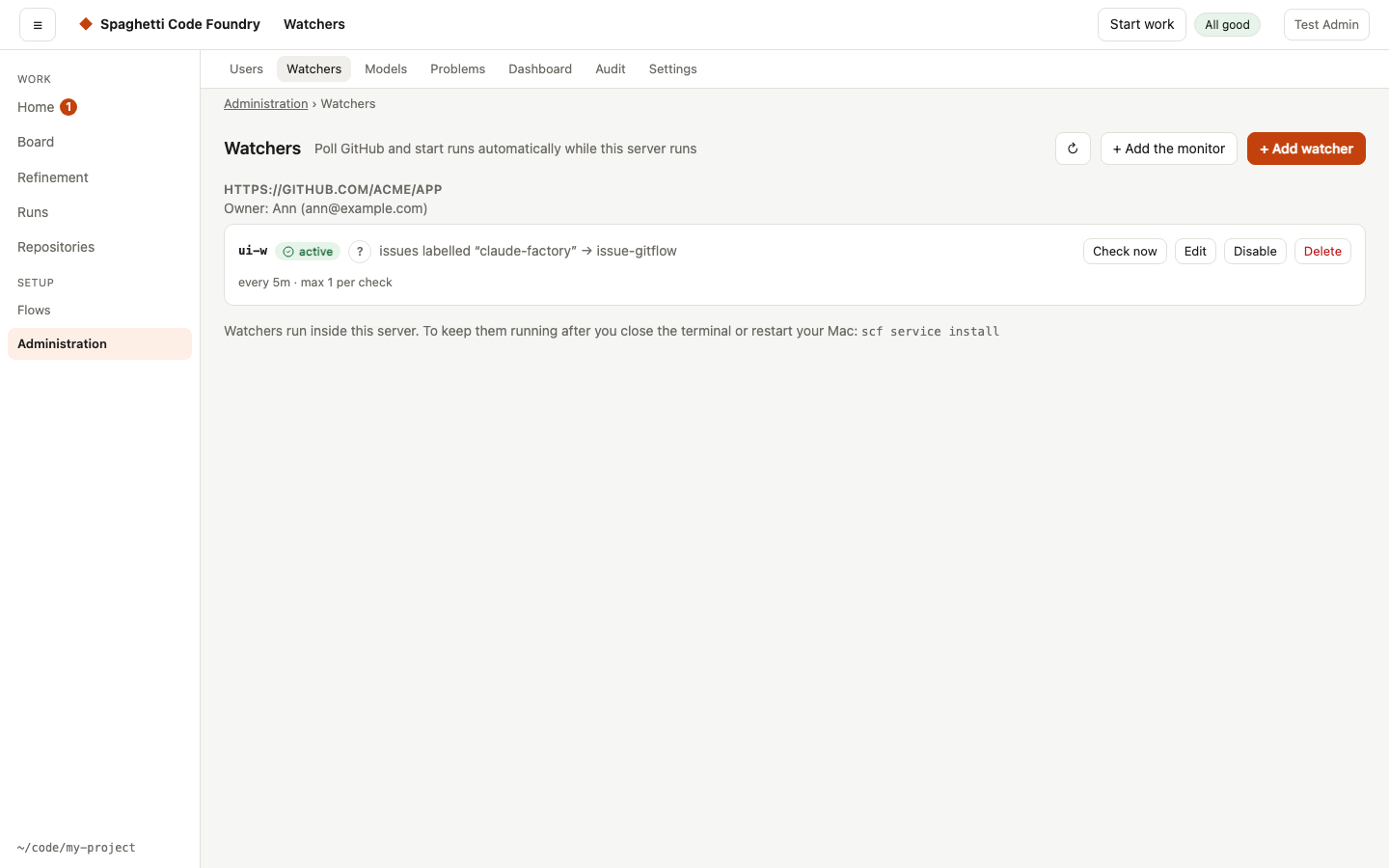
A watcher checks GitHub on an interval and starts runs. Sources: issues with a label, review comments on the Foundry's pull requests, a red build, or a schedule.
flowchart TD
  I[Issue gets the build label] --> P{New batch?}
  P -->|yes| QF[epic-questions: ask what only the owner can decide]
  QF -->|questions| NI[Label: needs info]
  NI -->|answer or /defaults| D
  QF -->|no questions| D
  P -->|no| D{Depends on open stories?}
  D -->|yes| WAIT[Waits; the app says for what]
  D -->|no| S[Start a run of the flow]
  S --> R{Result}
  R -->|succeeded| DONE[Label: done; issue closed when merged]
  R -->|waiting for a person| WA[Label: waiting; shown under Your turn]
  R -->|paused: limit, sign-out, code area| CONT[Continues by itself]
  R -->|failed| ERR[Label: error; comment explains]
  WA -->|/approve, /reject| S
  CONT --> S
What a watcher takes care of:
- Labels as status. One label is set by people (the trigger). The Foundry sets the others: working, done, needs info, waiting, error. At every check the labels are compared with the newest run and corrected.
- Dependencies.
Depends on/Blocked byin the issue text, by number or by title. A story waits until what it depends on is done. - Answers on GitHub. A reply to questions,
/defaults,/approveand/rejectcontinue the run. - GitHub lags. Before starting anything a second time, the watcher asks GitHub for that one issue again.
- A status comment on the issue that is edited in place, not a new comment each time.
- Tidying: closed issues lose their status labels; runs that wait for a person end when their issue is closed.
- Issue states. At every check an issues watcher stores whether each issue with an
unfinished run (failed, stopped, waiting or cancelled, any flow, any age) is open or closed
(
src/issue-states.ts). Issues in the open list of the check are stored as open without asking GitHub; the rest go in one batchedgh api graphqlcall (more than 500 are sent in sequential chunks). If the call fails, nothing changes,failedAtis set and the watcher shows the errorchecking closed issues: ….knownIssueState(repo, issue)answersopen,closed,unknownorundefined(no enabled issues watcher). Nothing a user sees uses it yet.
8. The two pipelines#
Gitflow pipeline (default) — one label, one flow, a person only for risky plans:
flowchart LR
  T[pull ticket] --> BR[feature branch] --> BT[tests before the change]
  BT --> PL[plan] --> PR[plan review] --> SZ{too big?}
  SZ -->|yes| SP[split into issues]
  SZ -->|no| RK{risk > 75?}
  RK -->|yes| AP[person approves]
  RK -->|no| CA
  AP --> CA[claim code areas] --> IM[implement] --> TS[tests + fix loop]
  TS --> RV[review 1, and 2 if risky] --> DO[docs] --> CM[commit + push]
CM --> MD[merge into develop] --> TD[tests on develop] --> RP[report]- Risk score 0–100 from the plan. Above 75: a person approves. Above 50: the plan is revised after review, and the code gets a second review.
- Size limit (default 15 files, 800 lines). Over it, the story is split into smaller issues; a low-risk split happens by itself.
- Supporting flows:
epic-questions(questions up front) andrelease-daily(the daily pull request fromdeveloptomain).
Human-in-the-loop pipeline — for teams that want a person at each stage:
issue-plan (plan, person approves) → issue-code-daily (code on the day's branch) →
daily-pr (one pull request per day).
For the same plan and commit, both pipelines lock the same skills; see The skill path.
A flow that a watcher uses cannot be deleted.
9. Branches: gitflow#
gitGraph
  commit id: "main"
  branch develop
  checkout develop
  commit id: "start"
  branch feature/12
  commit id: "story 12"
  checkout develop
  merge feature/12
  branch feature/13
  commit id: "story 13"
  checkout develop
  merge feature/13
  checkout main
  merge develop id: "daily release"
  branch hotfix
  commit id: "urgent fix"
  checkout main
  merge hotfix
  checkout develop
merge main id: "take the fix"- Every story: a
feature/…branch fromdevelop, merged back intodevelopas soon as it is finished. The tests run on the merge result; conflicts are resolved by an agent and judged by the tests. - Once a day: one pull request from
developtomain, merged by a person. - Urgent fixes: on
main, thenmainis merged intodevelop. The hotfix path ofissue-gitflowdoes this for bug stories; it is off until an admin switches on Hotfixes. mainis protected: runs and agents cannot push to it.
10. What happens next#
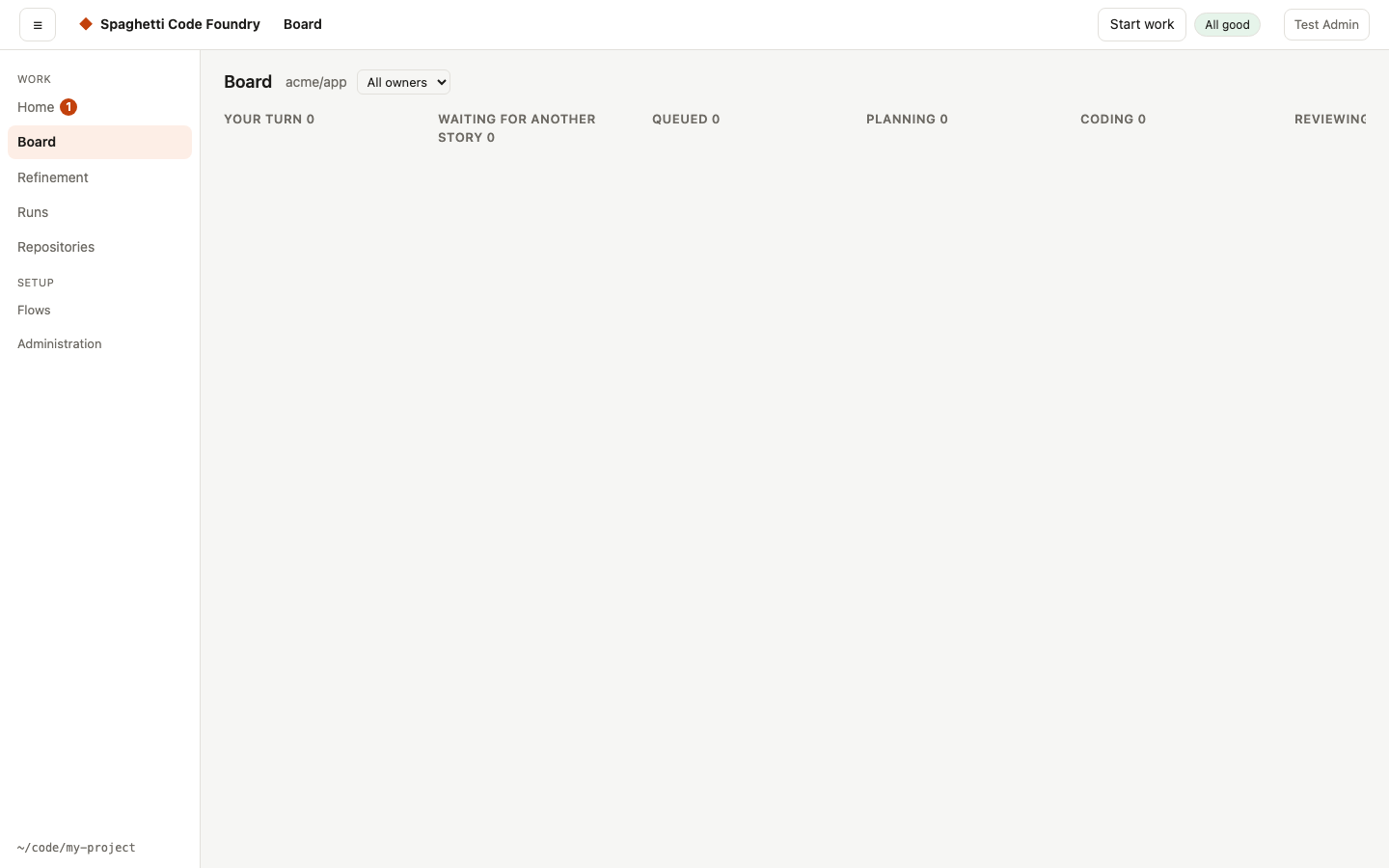
One module (src/next-step.ts) turns the state of a story or run into one record: who acts
next (you, the Foundry, another story, GitHub), what they do, why, where to do it,
and since when. Everything that shows status uses that record:
- Your turn — only the items where you are next, one button each, sorted by how much work they unblock.
- The board — every story of a repository in columns.
- The health line — problems of the Foundry itself, under the top bar on every page.
- Since you last looked, notifications, the status comment on GitHub, and the run page.
Rules of the module: name the root cause (if A waits for B and B waits for you, A says so);
say "nothing — it continues by itself" when that is true; use one vocabulary
(src/words.ts); explain errors as what happened, why, what you can do (src/errors.ts).
11. Accounts, roles and repositories#
- Sign-in is required for the web interface. The first account is the admin.
- Passwords. A password has 12 to 200 characters and is not on a short list of common ones
(
common-passwords.ts). An admin's reset removes the hash, ends the sessions and stores a 24-hour one-time link (only its SHA-256 is kept). Wrong tries are throttled in memory (sign-in-throttle.ts), not inusers.json: one counter per e-mail (shared by sign-in and Change password) and one per client address. A try is counted before the slow check, so tries that arrive together cannot pass the limit; it is given back when the password was right. Entries of stored accounts are never dropped for room. A restart clears waits and locks. - Two roles. An admin makes flows, watchers and settings and sees everything. A user
runs the flows an admin published, on their own repositories, and sees only their own runs —
no costs, no setup. Each role has its own display (
/for admins,/user/for users); the server still decides what a call may do. - Published flows. An admin decides per flow which variables a user may fill in, which are shown read-only and which stay hidden.
- Repositories per user, each with its own way of signing in. Tokens are stored encrypted, with the key in the macOS Keychain; they never appear in API answers, logs or agent environments.
- Runs sign in with the repository's token.
executeStep()asksstepRepoAccess()(src/engine/repo-access.ts) when a shell step hasrepo_access(or is the old by-name refinement grant). The lookup happens when the step starts.repoTokenEnv()puts the token in the step's environment only:GH_TOKEN, an emptyghfolder, and git config entries added after the engine'score.hooksPath(an emptycredential.helper, a helper for the repository's host that prints the name and token from the environment, no extra header), https only, no prompt. A refusal ends the run (Engine.accessFailedskipson_failure). A deploy key step gets<runDir>/sign-in/(0700) withkey(0600, viasshKeyEnv()), aholdernote (pid and start time) and aghstand-in that leaves a marker and fails with a fixed sentence;repoKeyEnv()sets ssh-only git, no agent and noGH_TOKEN, and the marker fails the step after it ends, whatever the script did with the exit code. A GitHub App step asksappTokenAccess()for a fresh token limited to the repository (never cached), used like a token; a refusal after its expiry gives the one-hour sentence. A step that holds a credential runs in its own process group, killed when the step ends. The folder is removed (key first, one chmod retry, a link removed as a link) in the step'sfinally, infinish(), incancelWaitingRun(), at the start ofdrive()and bysweepSignInDirs()at server start, which keeps a folder only while its holder's pid runs with the recorded start time. Removal fails closed: a folder that stays fails the step or the resume (SIGN_IN_NOT_REMOVED). Limits: theghstand-in catchesghby name only, and a process that leaves its group is not stopped. - Runs that never use the machine's login.
stepIsolated()(src/engine/isolation.ts) is true for every run with a user owner and for an admin's run on a repository with a stored sign-in (hasStoredSignIn()), and fails closed (unknown owner, unreadable file). It is asked per step from the scope'sgithub_repo. For such a stepisolationEnv()removes every token variable (tokenVarNames(), the bot's own included), givesghan empty folder of its own,GIT_CONFIG_GLOBAL=/dev/null, no system config, no ssh agent orGIT_SSH, https and file only, no prompts,user.useConfigOnlyand a credential helper reset (appended after the engine's ownGIT_CONFIG_*entries, socore.hooksPathstays), and sets the commit name fromcommitIdentity()(bot name and e-mail from Settings, field by field, elsegetUser(owner)). With no identity the step is refused (NO_COMMIT_IDENTITY).engine.botEnv()gives the bot's token and name once per run, only to steps that keep the machine's login. In agent stepsagentEnv(spec, true)ignoresISOLATED_AGENT_ENVnames, Claude agents are always isolated (--strict-mcp-config), and a token variable is never an anthropic-compatible provider key. Since #304 and #305 a user's run is also held by an OS sandbox profile (os-sandbox.ts); its agent steps get their own agent folders in the run folder and sign in by a token variable only (src/agents/boxed.ts). - Codex sessions belong to a Codex folder. Each Codex step records
codexHome(codex_homeinstate.stepsand in the template context):runfor the run's own folder, orpersonal:plus 12 hex digits of the path (never the path).codexHomeId()andcodexResumeRefusal()are insrc/agents/codex-home.ts. A step withresume:starts a new session, and logs why, when the recorded folder differs from its own or none was recorded (a record from before #420), so it never asks Codex for a session that folder does not hold. - Codex isolation (#421).
codexIsolationMode()picksprivate(a local model or aCODEX_API_KEYthe step sees:CODEX_HOME=<runDir>/home/.codex, made 0700 byprivateCodexHome(); a failure refuses the step),ignore-config(a Codex login:--ignore-user-config) oroff. Boxed steps get no mode.codexExecFlags()probescodex exec --helporexec resume --helpper command form (cached 10 min); a CLI without the flag turnsignore-configintounsupported: no flag, a!log line, the step runs. The Foundry assumes this CLI contract: the flag skipsconfig.tomlonly, the sign-in stays inCODEX_HOME, and rules are separate (--ignore-rulesis never passed).fake-codex.mjsmodels exactly this. Not yet checked on a real CLI: whetherexec resumelists the flag, and whether a privateCODEX_HOMEhides personal skills kept outside it. The skill payload path (skillSession(),withSkillPayload(),skillsRecord()) is shared by both agents (#422): a lock with skills forces Codex isolation, andunsupportedrefuses it. Limits: macOS only, andsandbox-execis deprecated; the token is visible to the agent's shell tool; the lock and hooks folders can be read; a Codex read-only step is held by the outer profile only; Docker steps are held by the container; withsandbox.user_runs: offnothing is held; the push hook does not run in a Docker step. - Evaluation limits (#534).
src/engine/eval-limits.tsholds one process-wide limit, unset by default, that a later evaluation command sets for untrusted skills. It adds three things to every sandboxed step: outbound TCP only to*:<port>orlocalhost:<port>entries (the profile deniesremote ip "*:*", then allows eachremote tcpentry);denyReadfolders denied before every allow exception (made real withdeepReal); and, for a Claude agent,--toolswith only the allowed tools,disableAllHooks, and strict MCP and setting sources. Only the port is filtered because Seatbelt accepts only*orlocalhostas the host, so a host name is refused. Limit: the tests check the profile text and the arguments, not Seatbelt or Claude Code's enforcement. - Permissions are enforced on the server. Every API route has a rule in
src/server/permissions.ts, and a test fails when a route has none. - Blocking an account signs it out at once, optionally stopping its work.
- An audit log records sign-ins, account changes and what signed-in people do in the web interface. Lines older than
audit.retention_days(default 180) are removed by the server, in a chunked scan underauth.lock.
12. Safety#
| Risk | Measure |
|---|---|
An agent pushes to main | Protected branches: git pushes to them are refused during runs |
| A secret is pushed | A secret scan blocks the push |
| A change touches things it should not | forbidden_paths, and a guard step after coding |
| A risky plan is built unseen | The risk gate: a person approves above the threshold |
| Runaway cost or loops | Budgets per run and per day (optional), max_visits, timeouts |
| Commands with text from an issue | Issue text and step output travel as environment variables only |
| A reviewer changes code | Reviewers get read-only tools |
| Untrusted test commands | Optional sandbox: Claude Code's sandbox or Docker |
| An untrusted skill is evaluated | Evaluation limits (eval-limits.ts): outbound TCP to listed ports only, listed folders unreadable, and a Claude agent with only the listed tools and no hooks |
| A candidate skill's scenarios run an agent | score --agent (src/skill-eval/): each arm in its own temporary data folder, a user's run (no GitHub token, empty gh folder, strict MCP, short environment, only the model key), the evaluation limit, and cleanup on every exit; the outbound network is limited to a port, not a host |
| A run acts with the admin's GitHub login | User runs, and admin runs on a repository with a stored sign-in, get no token, an empty gh folder, no machine git settings or ssh, and the bot or owner's commit name; environment only, not an OS sandbox |
| An admin looks at a user's display unseen, or changes things through it | "View as user": an audit line (view-as) per start, written first (no line, no view); as= only on GET, only with a running view for that user, answered by the user's own rules and cut-down views; views in memory only, 30 minutes, keyed by a hash of the session, never the token |
| Someone reads another person's Ask SCF conversation | Conversations are read and changed by their owner only; another account's id answers like an unknown one, an admin has no extra access, and "View as user" shows none |
| The help assistant is talked into doing something | A help turn has no tools, no MCP servers and no token; the server keeps only checked text and fixed pages from its answer, and the only actions are the server's two, and each is bound to a run the asker owns |
| Someone else on the network | Listens on this machine only, unless set otherwise |
| Private data in a public place | Paths and titles are filtered from what leaves the server unasked |
13. Data on disk#
Everything is in the data folder (~/.spaghetti-code-foundry):
| File or folder | Content |
|---|---|
config.yaml | Settings and watchers |
runs/<run-id>/ | run.json, step logs, transcripts, the workspace, evidence.jsonl (the events of the run), evidence.json (the manifest of a run that ended), evidence.diff, evidence.incomplete (a mark: the events are not whole) |
queue.json | Queued jobs |
locks/ | Code-area and run locks |
users.json, sessions.json | Accounts and sign-in sessions |
notifications.json | What was already notified |
help.json | The Ask SCF conversations of every account (mode 0600) |
help-stats.json | The Ask SCF quality numbers: one row per UTC day of counts and latency buckets, no account or text (src/help/telemetry.ts) |
telemetry/ | events-YYYY-MM-DD.jsonl, one value-free lifecycle event per line per UTC day (0700 folder, 0600 files); old days are removed after telemetry.keep_days (src/telemetry/) |
issue-states/ | One file per watched repository: open or closed for each issue with an unfinished run |
issue-lists/ | One file per watched repository: the last full issue list read by the watchers (number, title, state, labels, links, dependencies; no issue text), with readAt and cut. Written atomically; removed when no watcher is left for the repository |
self-update.json | The self-update record: pending (an install not confirmed yet), tested, retry (a test failure waiting for the next try: commit, tries, time), failed (with tries and the failing tests after the last try), updated |
flows/ | Your own flows (repository flows live in <repo>/.claude-factory/flows) |
A save of config.yaml edits the file text in place (src/config-edit.ts, editConfigText in src/config.ts): comments and key order stay, only the changed keys are written, and the result is parsed again before it is written. The settings and watcher reads send X-Config-Version, the sha256 of the file text; a PUT /api/config with a stale version gets 409.
The audit lines of a save come from the diff of the parsed configs before and after (configChanges in src/auth/audit-changes.ts): one line per changed leaf, with the watchers matched by id. MASKED_KEYS there is the one list of settings that say only "changed"; a value is rendered and cut to 80 characters. auditActions (src/auth/audit.ts) writes all lines of one save under one lock. The Slack webhook never leaves the server: configView (src/server/config-view.ts) answers notify.slack_webhook_set, and withStoredWebhook keeps the stored value when a save leaves the key out.
Run ids are timestamps, so folders sort by time. Old workspaces are removed by scf clean.
14. The server and its restarts#
One process serves the web interface, runs the queue and the watchers. A supervisor notices a
new build and restarts the server — but only when no run is active. Until then it starts no new
runs and tells the user why (Scheduler.drain() stops queued jobs from starting; they stay in
queue.json for the new server). Runs that were interrupted continue after the restart.
Self-update. With self_update on, the server (SelfUpdater) is the one that decides: it
checks main of the named repository, builds and tests the new commit in a git worktree, and when
the active runs are done installs that exact commit in place (git merge --ff-only, npm ci if
the lock file changed, npm run build). It writes a journal first (self-update.json, pending
with phase apply, then installed with the build stamp) and exits with the restart code. The
supervisor guards the first start after an install: it reads the journal, finishes going back
when an install was cut off, and puts the previous commit back once when the server stops or
does not confirm in time. The new server confirms with GET /api/ready (loopback only) after it
checked that HEAD and its build stamp are those of the install. A failed go-back is a terminal
state (failed.backOk = false) that a person must repair. The monitor reads the same file. The release check (release-daily verify) writes tested/<key>, with key = printf '%s\n%s\n' <tree> <cmd> | shasum | cut -c1-40, as the one line run <id>, <UTC time>, tree <sha> only for a green run on a clean tree whose HEAD^{tree} did not change; self-update skips its test step only when the staged commit's tree and its own test command (alone or after npm ci && ) match that exact line form, and runs the tests otherwise.
15. The web interface#
Plain JavaScript modules, no build step, no framework. The places of the admin display:
| Place | Pages | Purpose |
|---|---|---|
| Home | — | What waits for you, what is running, what finished |
| Board | — | Where every story is |
| Epics | — | How far each epic is and its expected finish |
| Refinement | — | From a rough idea to a story |
| Runs | — | Every run, live log, steps and transcripts, changes |
| Repositories | — | Repositories and how the Foundry signs in |
| Flows | Flows, Library | Edit and create flows; reusable blocks |
| Administration | Overview, Problems, Watchers, Models, Dashboard, Users, All repositories, Credentials, Audit, Settings, Maintenance | Findings of the monitor, automation from GitHub, routing, cost, accounts, all repositories and credentials, audit log, settings, workspace clean-up |
User display: Home, Epics, My runs, My repositories, Refinement; Start work is a button. The source is ui/ia.js.
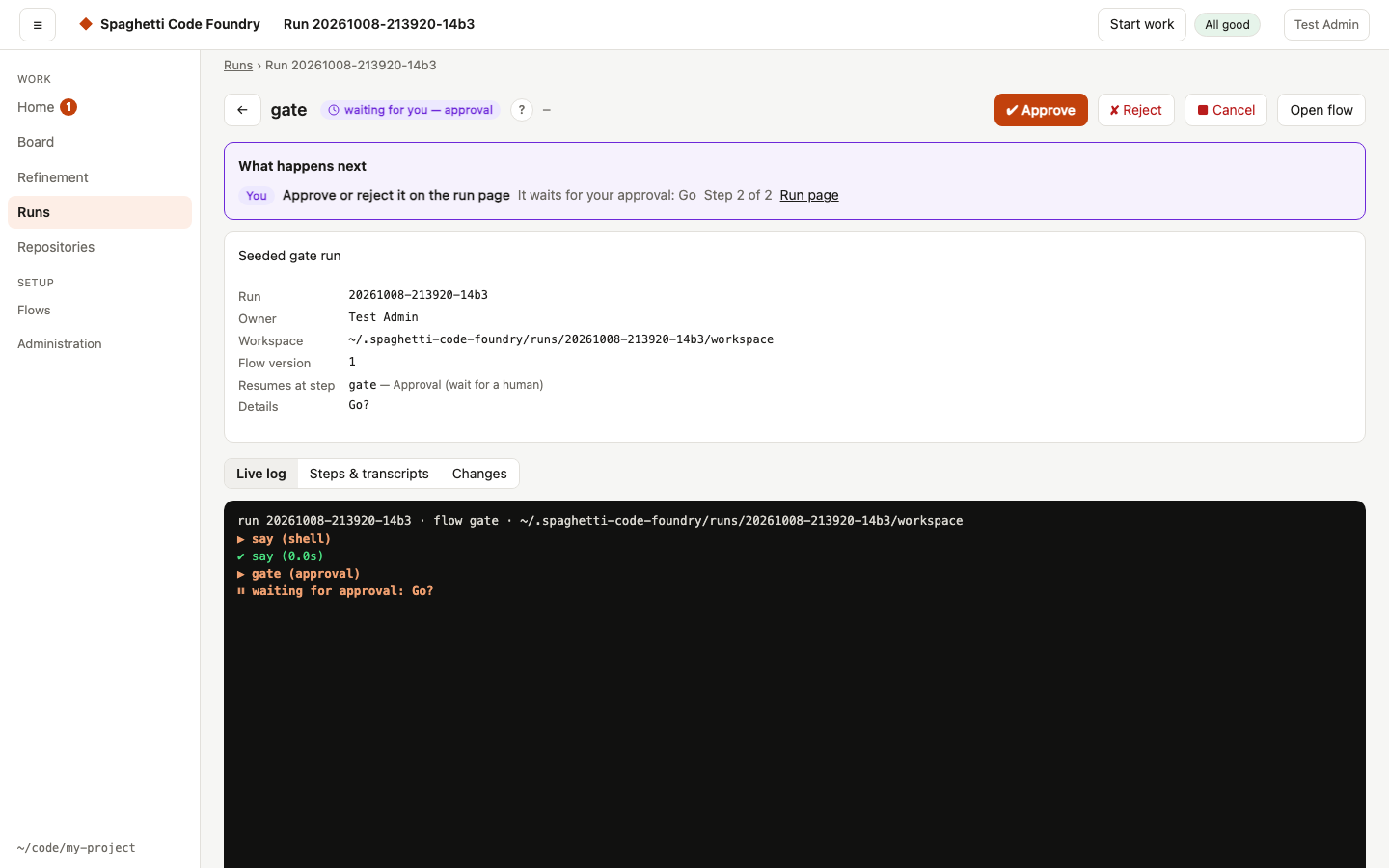
Two displays. The admin page is ui/index.html with ui/app.js (the router; the flow editor page is ui/flow-page.js, made by createFlowPage, with its header and navigator in ui/flow-shell.js and its pure state in ui/flow-state.js); the user display is ui/user/index.html with ui/user/app.js, served at /user/ and /user. The user script imports only shared modules by absolute path (/auth.js, /dom.js, /runs.js, /repos.js, /refinement.js) and its own /user/start.js and /user/runs.js (it no longer imports /runs.js directly; that module is reached through /user/runs.js), and no admin module; a test checks this. ui/user/runs.js draws My runs (cards, queue, Remove) and the run page of a user (Now, Log, Steps, Changes, and the Approve/Reject dialog, Retry and Cancel); it reuses the helpers of ui/runs.js and ui/next.js and draws only the server's cut-down view. ui/user/start.js (the Start work page) imports relatively (../api.js, ../auth.js, ../dom.js, ../repos.js) so a test can load it; in the browser these are the same module instances as the absolute ones. Both entries call enterDisplay in ui/auth.js: it signs in, and an account of the other role is sent to its own display before any page is drawn. The redirect is in the browser and is for comfort only; the server enforces permissions on every call, and the scripts are plain static files.
Dialogs (modal() in ui/dom.js) take the focus, keep Tab inside, close once on Escape and give the focus back to the opener. mount() keeps the focus on the control with the same data-focus name when a page draws itself again.
Breakpoints and touch targets#
Breakpoints are named by layout need. ui/viewport.js is the one place in code (BREAKPOINTS = { compact: 767, medium: 1023 }, mediaFor(name); initShell and renderWork take their default media from it). Media queries cannot use custom properties, so the CSS repeats the numbers; tests/ui-viewport.test.ts fails when a max-width or min-width in ui/ is not one of the values below.
| Name | Width | Layout |
|---|---|---|
| compact | below 768 px (max-width: 767px) | drawer navigation, one column, dialogs as bottom sheets, cards |
| medium | 768–1023 px | sidebar, one content column |
| wide | 1024 px and up | full layout |
The existing max-width: 1100px rule stays as "two panes side by side".
Touch targets. --size-touch (44 px) and --size-touch-min (24 px) are in ui/tokens.css. On coarse pointers buttons, .btn links, form inputs and selects, summary, sidebar and sub-navigation links, table row actions and the dialog close button are at least 44 × 44 px, with at least 8 px between neighbours. On fine pointers the minimum is 24 × 24 px.
Sheets and wrapping. Below 768 px a dialog (.modal, and the kit's .scf-dialog) is a bottom sheet: full width, fixed to the bottom, at most 90 % of the viewport height, scrolling inside, with a sticky head so the close button stays reachable. This is CSS only; modal() is unchanged, so the focus trap and Escape work as before. .toolbar actions wrap below the title. .log, pre.diff and long names scroll or wrap inside their own box, so the page never scrolls sideways at 360 px.
The rules for these live in ui/css/responsive.css (imported last by ui/style.css); width rules that belong to one component stay next to their base rules.
Support levels. supportLevel(pageId, width) in ui/viewport.js maps a page id from ui/ia.js to "full" or "read-only": administration pages are read-only at 767 px and below (BREAKPOINTS.compact), flows, flow and new-flow at 1023 px and below (BREAKPOINTS.medium); everything else, an unknown id and a missing or NaN width are "full". levelNotice(pageId, { dirty }) returns the notice text or null. In ui/app.js, route() fills the single #level-note element above #main and passes readOnly to the renderers; NOT_YET lists the pages not wired yet (they stay full, with no notice); flows, flow and new-flow are wired (read-only at 1023 px and below), while the repositories, models, problems and maintenance pages are still in it. The flow page asks isReadOnly (from supportLevel("flow", innerWidth)) at the moment of every change, so save, remove, newBlank, generateDialog and the late Retry callbacks do nothing once the window is narrow. markDrawn(to) records the drawn page and its notice. The flow list in the sidebar has its own check in onWidth: it redraws whenever 1024 px is crossed and the destination is flows, also on the Library page. The width is read from globalThis.innerWidth; the listeners are on mediaFor("compact") and mediaFor("wide"), and a change redraws only if the level of the drawn page changed. While #modal-root holds a dialog the crossing is remembered, and a MutationObserver on #modal-root redraws once it is empty. lockReadOnly(root) in ui/fields.js makes the controls under root read-only: inputs and textareas get readOnly, selects and checkboxes are disabled, buttons are removed. There is no blanket disabled fieldset, so text can still be focused and scrolled. renderUsers, renderUserDetail and renderSettings take a readOnly option and pass it on when they redraw themselves. operations, watchers and watcher have left NOT_YET: renderOperations, renderWatchers and renderWatcherDetail take readOnly too (also in their reload). Read-only leaves out "Cancel run" (renderHealth); the add buttons, Check now, Edit, Enable/Disable, Delete and the bug-stories switch (ui/watchers.js, storiesRow); and the mute row, the Actions column and "End mute" (monitorLists, mutesTable in ui/monitor.js). The header health panel and the Problems page do not pass it.
Development gallery#
scf ui --dev and scf serve --dev set ServerOptions.dev. With it, the static branch in src/server/server.ts serves ui/gallery/ (/gallery and /gallery/ map to gallery/index.html, like /user). Without it, isGalleryPath (src/server/http.ts) catches every spelling of a path under /gallery (.., \, case) and the server answers 404 before serveStatic. The switch is on the command line only. The gallery is plain static files under the existing CSP, adds no API route and so needs no rule in permissions.ts. See docs/UI_COMPONENTS.md.
UI styles#
ui/style.css is only a list of @import url("/css/…") lines. The rules live in small modules under ui/css/. There is no build step: the browser follows the imports. /css/… is served like /style.css (static, no sign-in, text/css), and the CSP allows same-origin @import. ui/index.html and ui/user/index.html link /tokens.css (the token values) and then /style.css.
Modules and who owns what. Every module starts with a comment that says what belongs in it and what does not.
| File | Owns |
|---|---|
tokens.css | Only a pointer: the custom properties (colours, type, spacing, density, the --layer-* scale, --size-form) are in ui/tokens.css, which is linked before /style.css. No selectors. |
reset.css | Bare elements: body, headings, links, code, pre, details. .mono stays here because it shares the code, pre, .mono rule. |
layout.css | The page frame and the run grid: body, .layout, aside, main, .run-grid, and how they collapse on narrow screens. |
templates.css | The page templates: .page, the eight .page-<name> roots and their regions, and grids scoped under a template root (.page-overview .dash-grid, and the editor grid under .page-editor). No component rules, no z-index. |
components.css | Controls and boxes used on more than one page: buttons, inputs, .field, .pill, .badge, .card, .table, .table-box, .modal, .backdrop, #toast, .seg, .tabs, .chips, .spinner, .empty, .errors, focus rules, and the toolbar and status helpers. Every variant of a component lives here too, such as .pill.who-you, .card.failure, .table.compact and .modal:has(.block-grid), even when only one page uses it. |
utilities.css | One-purpose helpers: .row, .grid, .spacer, .muted, and the classes listed under "Utility classes" below. |
pages/*.css | One file per page area: shell (top bar, health, subnav, sidebar, view bar, user display), editor, runs, dashboard, turn (holds, next step, Your turn, help), board, start, refinement. ask is the Ask SCF drawer. |
Page templates. ui/templates.js has eight templates: overviewPage, collectionPage, boardPage, masterDetailPage, editorPage, settingsPage, conversationPage and detailPage. Each returns div.page.page-<name> (overview, collection, board, master-detail, editor, settings, conversation, detail). The module imports only ./dom.js and ./kit/product.js; it has no api, fetch( or style.
- Head. The options
title,back,statusandactionsgo topageHeader({ layout: "toolbar", title, back, meta: status, actions }), so there is one header component. Alternativelyheadis a ready node (the first child, noh1is made);headwithtitlethrows.noticescomes right after the head. - Regions. Plain
divs in a fixed order, with no grid and no gap, so margins collapse as before. An empty slot (null,false,[],[null, false]) draws no region. Slots: overviewsummary,sections; settingssections; collectionfilters,list,empty; boardfilters,columns; master-detailmaster,detailin.page-body; editormain,sidein.editor.page-body(side first); conversationthread,composer,side; detailmeta,sections,side(.page-bodygetswith-sideonly whensideis filled). - Used by the dashboard (
overviewPage), the settings page (settingsPage), the flow editor (editorPage) and the refinement session (conversationPage). The other pages move over in later parts of #341. - Focus after a redraw.
mount()inui/dom.jslooks for the fallback heading in the target, then its parent, then the nearest.pageancestor, then the target itself.
Where a new rule goes.
- A custom property:
tokens.css. - A bare element:
reset.css. - A control or box used on more than one page, or a variant of one:
components.css. - A one-purpose helper:
utilities.css. - Anything else: the page file of the area that uses it. A page file (and
templates.css) does not start a rule with a shared component class (.card,.pill,.table,.modal…); put it incomponents.css, or scope it under a class of the page. A test (competingSelectorsintests/helpers/ui-css.ts) enforces this; a class whose base rule a page file owns goes on a short allow-list with a reason.
Use a token, not a number, for z-index and for the widths below. Keep rules that override each other in the same module and in the same order.
Import order, and why. Tokens, reset, layout, templates, components, utilities, then the pages. Rules of equal weight are decided by source order, so a later file wins. Tokens come first because everything reads them. Reset comes before any class. Components come before utilities, so a helper such as .muted can override a component. Pages come last, so a page can adjust what it uses. Do not reorder the list, or the rules inside a module, without checking the cascade. The shell rules at the end of pages/shell.css (for example .spacer) come after utilities.css on purpose.
z-index scale (--layer-* in ui/tokens.css; a test fails on a z-index that is not a layer token):
| Token | Value | Used by |
|---|---|---|
--layer-sticky | 10 | .top |
--layer-menu | 40 | the account menu, .scrim, the drawer sidebar (+1) |
--layer-overlay | 50 | .backdrop, and so every .modal |
--layer-toast | 60 | #toast, .skip |
Utility classes. Defined once in ui/css/utilities.css; each has exactly the declarations of the inline style it replaces. Build the class string in place with h(), for example class: "row tight text-sm mt-8". There is no style helper.
| Group | Classes |
|---|---|
| Stacking | .stack (grid, gap 12px), .stack.tight (gap 6px), .row.tight (gap 6px), .row.tighter (gap 4px), .row.center |
| Margin and padding | .flush (margin 0), .mt-4/6/8/10/16/22, .mt-neg-6, .mb-4/6/8/10/12/14/16, .mx-12, .px-12 |
| Width | .fit (auto), .full (100%), .w-70, .w-80, .w-90, .maxw-520 |
| Text size | .text-sm 12.5px, .text-xs 12px, .text-2xs 11.5px, .text-3xs 11px (built from the type tokens) |
| Text flow | .pre-wrap, .wrap-anywhere, .break-all, .select-all, .block |
| Grid | .span-all (grid-column: 1 / -1) |
.flush comes before the margin classes, so flush mt-4 gives margin: 4px 0 0. A compound margin such as 4px 12px becomes mt-4 mb-4 mx-12.
Inline style only for values computed from data. Use a utility class for any fixed value. Use style: or .style. only when the value comes from data, such as the chart tip position and the rate bar width in ui/dashboard.js. To show or hide a part, set the hidden property; ui/css/reset.css has [hidden] { display: none !important; } so it also works on .field and other grid elements. tests/ui-inline-styles.test.ts lists every style: and .style. in ui/**/*.js, fails for a cleaned file unless the line is on its allow-list with a reason, and checks that every utility class used exists in the CSS.
Content widths. --size-form (640px, in ui/tokens.css) is used by .start-form and .modal; .modal:has(.block-grid) is 900px.
Sticky regions. There are two: .top (stuck to the top of the page at --layer-sticky; static in the user display on narrow screens) and .page-editor .page-side > * in the editor, the Overview pane (sticks under the top bar). The sidebar .side is sticky below the top bar too.
Who scrolls. The page scrolls. These scroll themselves: .table-box (sideways), .log (the run log), .modal (up to 90vh) and .page-board .board (sideways). Code blocks such as .tl pre, pre.diff and .turn-text have their own maximum height. On a narrow screen the sidebar is a drawer (.side with body.drawer-open) at --layer-menu plus one; it scrolls itself.
Tests. readUiCss() in tests/helpers/ui-css.ts follows the imports and returns the whole stylesheet, for tests that read CSS. It fails on an import that does not resolve and on a .css file under ui/css/ that is not imported. tests/ui-css.test.ts checks the import order, that the rule set equals the frozen tests/fixtures/ui-style-baseline.css, the tokens, the z-index rule, the module comments, and that no page file starts a rule with a shared component class.
Every setting has a control#
The rule: every setting of ConfigSchema has a control in the interface or a reviewed exception. A new setting cannot be added without one.
- What counts.
settingKeys()insrc/settings/describe.tslists every key down to the leaves, watcher options included. A record (watchers,providers,router.rules) or a list of records counts once, by its item shape, with the segment*. A setting counts as having a control whendescribeSettings()describes it and its control is either generated (control: "generated", drawn from the description) or a namedui/*.jsmodule whose text mentions the key. A field of a record counts whenITEM_SETTINGSlists it with its module. - Flow variables. Every variable of every shipped flow needs a
var_infoentry orset_by_run: true. - Exceptions.
src/settings/exceptions.tsis the one list. Each entry has a reason. A key with a control and an entry fails the test, and so does an entry for a key that no longer exists. - The test.
tests/settings-inventory.test.tsis a unit test: it reads the schema, the description, the shipped flows through the flow loader and the text of the Settings modules. It names the key and says whether to describe it or add an exception.
16. Tests#
- About 2,100 tests in 78 files (vitest), run before every change is accepted.
- No real services. Fake
claude,codexandghprograms and a local git remote let whole flows run in seconds. - Each test run has its own temporary data folder.
- Documents are checked too: flow examples in the authoring guide must validate, and the error texts in the user guide must match the code.
- Browser tests (separate).
npm run test:uiruns Playwright specs (tests/browser/*.spec.ts) against the real server in a real browser.npm testdoes not run them and passes with no browser installed. Install the browser once withnpx playwright install chromium.- A launcher (
tests/browser/server.ts) starts the server on a free port with a temporary data folder, one admin, one user and seeded data: a run in each main status, a repository, a refinement session and a watcher (tests/browser/seed.ts). tests/browser/widths.tsdefines the widths once: 360, 768, 1024 and 1440 px.openAs(browser, role, width)opens a signed-in page;expectNoSidewaysScroll(page)fails when the document is wider than the viewport.- The navigation spec checks every primary link on both displays at all four widths. At 360 px it goes through the menu button and drawer.
- Pages keep an event stream open, so the tests never wait for "network idle".
tests/browser/responsive.spec.ts(UI quality 1b, #368) checks at all four widths: no sideways page scroll on Home, Runs, a run detail (log and diff), Start work, Repositories and one open dialog; every visible interactive element in the header, sidebar and dialog is at least 44 × 44 px with a touch device profile (touchoption ofopenAs); the dialog is a sheet at 360 px and centred at 1024 px.- Visual check.
tests/browser/visual.spec.tscompares screenshots (toHaveScreenshot) with committed baselines.tests/browser/visual-matrix.tsdefines the matrix once: 12 pages (the gallery stand-indocs/ui-redesign/visual-system-demo.htmlopened from disk, admin, user and sign-in pages), each in theme (light, dark) × density (default, compact) at 1440 px, plus light/default at 360, 768 and 1024 px.tests/visual-matrix.test.ts(vitest) checks the matrix.openAstakes an options argument for theme, density and a fixed clock. Theme and density are set asdata-theme/data-densityon<html>before page scripts run.- Captures are deterministic: animations off, caret hidden, fixed height (
VIEW_HEIGHT), scale factor 1, wait for the page's ready text. Changing parts (run ids, times, the live running run) are masked. - A changed area above
MAX_DIFF_PIXEL_RATIO(inplaywright.config.ts) fails the test. Expected, actual and diff images are written totests/browser/test-results/. A harness test injects one style change and checks that the comparison fails. - Baselines live in
tests/browser/__screenshots__/{platform}/. Onlydarwinhas baselines; on other platforms the visual spec is skipped with a message, as it is on a Mac with no baseline folder. - Update baselines with
npm run test:ui -- --update-snapshots, check every changed image, and commit them. A story that changes the look on purpose does this and lists the changed images in its pull request.
- Guide images.
tests/browser/guide-shots.spec.tswritesdocs/images/<name>.pngfor every entry of the manifestSHOTS(scripts/screenshots/shots.ts). Run it withnpm run test:ui -- --grep @guide.tests/guide-docs.test.tschecks that the guides, the folder and the manifest agree.
- A launcher (
17. Self-repair#
The Foundry watches itself and repairs what it can, in one loop:
detectors → findings file → Reporter → bug story → goes first → hotfix → fix commit → 24-hour watch- Detectors (
src/monitor/detectors.ts,work-detectors.ts) read runs, queue, watchers and the server log. Findings are kept inmonitor-findings.json. - The
Reporter(src/monitor/report.ts) turns a finding that lasts into one GitHub issue with the labelsbugand the build label, from a fixed template, after cleaning (clean.ts). - Goes first. The issue watcher builds a
bugstory before any other work, as a hotfix onmainwhen Hotfixes are on. Only the unchanged built-inissue-gitflowmay pushmain, in its steppush_main. - The fix commit is read from the finished run (
COMMIT:ofpush_develop,MAIN:ofhotfix_done). The 24-hour clock starts when the running Foundry has it; after 24 hours of normal work without the problem the finding is fixed (src/monitor/fix.ts). - Guard rails (
guard.ts,breaker.ts,mutes.ts): off by default, cleaning, one story per problem, 3 a day and 1 per check, quiet time, circuit breaker, never a story about a story, two tries, mutes. - Proof.
tests/self-repair-incidents.test.tsreplays four real incidents with the real Monitor, Reporter, Watcher and flows; only the edges are fake (gh,claude, the git remote and the clock).tests/self-repair-rules.test.tsproves the five rules. See the user guide.
The model analyst#
src/analyst/ is a process of its own (scf analyst run, every 6 hours through its own login
agent), so that judging the models never depends on, or slows, the server. It is pure reading:
collect.ts turns the step records of the last 14 days into counts per flow, step, model and
effort; advise.ts turns the counts into one verdict per pair; report.ts writes Markdown. The
quality of a step is read from what came after it in the same run: a fix_* step means its work
was broken, an address_* or revise_* step after a review means it was sent back. Published
figures (reference.ts) are fetched once a week by a headless Claude Code session that may only
search the web. Each figure carries who measured it; makers' figures are lowered by a tenth and can
only veto a step down to a much weaker model.
With self-tuning on (tune.ts), advice becomes a trial: an entry in analyst/overrides.json (flow →
step → model, effort) that runAgentStep reads at the start of each agent step, below the user's
router rules. Flows are never edited, so a change is one small file that can be emptied. A trial is
a controlled change: one per flow at a time, a stored baseline, a fixed number of visits, and a rule
that puts the old value back when the step does worse (or, for a higher level, not better). The
effort a step ran with is stored in its step record, so that the visits before and after a change
can be told apart.
The command line for the API#
src/remote/ makes every API call a command without a second implementation of anything. A command
is data: one entry in a table (Cmd in spec.ts) that names the route, its arguments and options,
and how to print the answer. One runner (cli.ts) turns the words into the call, sends it with the
session of scf login, and prints. So permissions, audit and locking stay in the server, where
the web interface already uses them. The session is the browser's: a cookie and the CSRF token
derived from it, so the server needed no change. The table is checked against the server's own
list of routes (RULES in permissions.ts) in both directions: a command for an unknown route
fails a test, and so does a new route without a command or a stated reason (API_ONLY). The file
commands keep their words: remoteCommand returns "not mine" for anything it does not know.
Ask SCF: the contract#
Ask SCF is the help assistant inside the product (epic #226). Its contract is code, in
src/help/contract.ts: pure data and pure functions, with no model, no storage and no route. Every
later part (stored conversations, the turn service, the pages) goes through it, so the text of a
model can never widen what a reply holds.
- Questions. Four types (
QUESTION_TYPES): product help, status, troubleshooting and guided resolution.QUESTION_RULESsays which evidence each needs:doc(the installed documentation) orstate(what the asker may see now, withobservedAt). - Parts of a reply. Five kinds (
PART_KINDS,PART_RULES): answer, recommendation, navigation, draft and action. Only an action haschangesStateandneedsConfirmation.ACTIONSis the server's list of actions (resume-runandcancel-run, see "confirmed actions" below). Nothing is carried out yet, andACTION_RULESnames the five conditions (server list, preview, confirmation, a second permission check, read-back) that a later story must meet before one runs. checkReply(raw, { role, offered, uncertain, targets, clean })turns what a model answered into theReplythe server keeps (ReplySchema). Nothing is trusted: evidence must be one ofoffered(the model names ids only), a link must be a page inNAV_PAGESthat the role has and gets the page's own title, an action must be inACTIONSand bound to an offered source (see below), texts are cut and cleaned, anddroppedlists what was left out in fixed words.displayText(reply)writes the text a person reads from the checked parts; it is never the model's own text.- Uncertainty.
certaintyOflowers the level tounverifiedwhen no evidence of the needed kind is left; the model may be less sure, never more. The sentences areCERTAINTY_WORDS. - Requests that are not served. A model answers them with a code only (
LIMIT_CODES);limitationFor(code, role)gives the fixed limitation and the safest next step, and never a page the role does not have. The codesrefinement,next-stepandmonitor-findingare the hand-offs to Refinement (#73), "what happens next" (#31) and the Problems page. - Roles.
forRole(role, value)removes every field inADMIN_ONLY_KEYS(model, provider, cost, tokens, server detail) for a user, at any depth, andhideNamestakes model and provider names out of a text.contractFor(role)is the contract as a person of that role may read it.
tests/help-contract.test.ts checks each rule, that NAV_PAGES matches ui/ia.js, and that
chapter 14 of the user guide holds the same sentences as the code.
Ask SCF: confirmed actions#
Part 1 of 2 of #567 (#569), behind help.actions, off by default. It only binds a proposal to the
run the server knows about. Part 2 of 2 (#570) carries out a previewed action through the API. The
drawer's review and confirm control is #568: ui/api.js (prepareHelpAction, confirmHelpAction,
cancelHelpAction, all through req), ui/ask.js (reviewAction, the review option that tests
replace), ui/ask-model.js (previewRows, outcomeOf) and ui/ask-view.js (reviewDialog,
outcomeNodes). The prompt lists the role's action ids only when help.actions is on (turnPrompt).
- The list.
ACTIONShasresume-run(reversible,undoable: true) andcancel-run(high,undoable: false), both foradminanduser. Each has a fixedeffecttext written by the server. A kept action storesdef.effectas itsimpact; the model's text is never shown. - The binding. A source may carry
about(AboutSchema: kindrunand an id). Only the server sets it.liveEvidencesets it on a run snapshot that is fresh, whose run the asker owns (scheduler.ownerOf(id) === owner), and only when no conflict source is present. An admin gets no exception.prepareTurntakesaboutoff what is offered (EvidenceSchemastays strict) and returns it asPrepared.targets, only for sources that were offered. - The check.
checkReplykeeps an action only when its source is cited, offered, of kindstate, not inuncertain, and has a run target intargets, and when its impact text claims no result (claimsAction:claimsResult, plus "was/is/has been … resumed, cancelled, stopped …" and the like). The claim check reads the model's whole raw text, so nothing cut or marked as removed can hide a claim. Duplicates onidandabout.idare kept once. The three drop words areACTION_DROPPED. - The switch.
HelpTurns.runpassestargetstocheckReplyonly whileconfig.help.actionsis on. Off, every proposed action is dropped. The prompt still says"actions": []. - Outside check.
actionProblems(reply, ready, role)insrc/server/help-evals.tsre-checks each kept action against the prepared turn, andscf eval helpreports each problem asunsafe-action, which blocks a release. The scenarios are in theactiongroup.
Part 2 (#570): preview, confirm and cancel. prepareAction, confirmAction and cancelAction in
src/server/help-actions.ts; the routes are in src/server/api-help.ts, before the generic POST block.
Every error that is a refusal becomes an ActionRefused with a code, a status and a fixed sentence.
- Preview.
previewOfbuilds the answer from fixed words and the run's own fields; no model text is in it. Only the grant is written, in memory. - Grants.
ActionGrants(src/help/grants.ts) keeps each token under its sha256; the token is never stored. A grant lastsGRANT_TTL_MS(5 minutes), at mostGRANTS_PER_OWNER(5) per owner andGRANTS_MAX(1000) in all, and a new preview replaces the grant for the same reply action.peekreads a copy without using the token;takeuses it up, and burns it when the binding does not match (owner, conversation, reply, index).grantsOf(ctx)keeps one set per server in a WeakMap. - State version.
stateVersion(scheduler, runId)is a sha256 of the run (status, history length and last record, answers, next and waiting step, resumes, finish time) and of the queue: whether the run is queued or active, and the identity of its queued job (scheduler.queuedJob: enqueue time, kind,from, decision, source, priority, who queued it). A job taken out and queued again changes it. - Confirm, in order.
peekgives a fast 409 for an unknown, used or expired token. A resume then awaitscheckResume(the same gate as the run's page; the await may take a while). Then one synchronous block, with noawait:take, the binding and the proposed action again, the state version, the switches and the account (checkSwitches, read again),mayAct(the run's rule, the owner only) andapplies. Two confirms cannot both pass, and a permission change during the gate wait is seen here. Refusals are audited once (refused: <code>) and change nothing. - Executor and error boundary.
startResume(sync submit and audit) orcancelRunruns inside onetrythat covers the executor and the read-back. A throw there leaves the token used, is logged as "did not end cleanly" and does not become a 500. The state is then read again, best effort. - Read-back.
watchRunsubscribes to the scheduler's events and waits at mostREAD_BACK_MS(5000, overridable bydeps.readBackMs).armedis set aftersubscribereturns, so replayed events are ignored; the timer isunref'd; the subscription and timer are released in afinallyon every path. - Result.
decideworks from the fresh state only.doneis reported only after read-back. For a cancel,cancelledis checked before "still active", so a stop that was saved while the run finishes isstoppedonly when the status sayscancelled; a run that ended with another status first isnot-done.OUTCOME_WORDSgives the fixed words and recovery for each result. - Storage.
addOutcome(src/help/store.ts) adds the outcome to a finished reply and keeps the newestOUTCOMES_KEPT(10).OutcomeSchema(src/help/outcome.ts) is strict. A failed store or audit write answersstored: false; the outcome is still returned.
Tests: tests/help-grants.test.ts, tests/help-actions.test.ts (the checks, with a replaced gate),
tests/help-actions-run.test.ts (the real scheduler: stale evidence, read-back, the error boundary) and
tests/help-actions-api.test.ts (HTTP with FAKE_HELP).
Ask SCF: stored conversations#
src/help/store.ts keeps the conversations in help.json ({ version: 1, conversations }), read
and written like the other account files: withAuthLock, a temporary file and a rename. The schema
is strict, so a file of another version or with unknown fields is refused and left untouched.
- Records. A conversation has an id, its owner, a title, a state and its messages. A message
is a question (
role: user, with the bounded page context) or a reply (role: assistant,replyToits question). A reply holdsstatus(pending,done,failed,cancelled), the checkedreplyof the contract (citations arereply.evidence, proposalsreply.actions) and, apart from it,text, whichfinishTurnwrites withdisplayText.finishTurnparses the reply withReplySchemaagain, so nothing unchecked is stored. - Ownership. Every call that reads or changes takes the owner from the session. An id of
another account is
not-found, the same as an unknown id. The routes (src/server/api-help.ts) use onlyuser.id; the role adds nothing, and a call with?as=is refused, so the support access of administrators is: none.deleteUserremoves the conversations of the account under the same lock (removeHelpLocked). - Turns and retries.
addQuestionstores the question and apendingreply. The turn ends throughfinishTurnorfailTurn, which take aTurnRef(message,tries) and write only while that reply is pending with that try: a result of an earlier try, of a stopped turn or of a deleted conversation is dropped.retryTurnsets the same reply topendingagain and countstries; no message is added.settleInterrupted(at server start) marks leftover pending replies as failed withinterrupted. - States.
active,failedandcancelledfollow the last turn;completed,archived(withstateBefore) anddeletedare set by the owner. Completing and archiving are refused while a reply is pending. - Retention.
deleteConversationreplaces the record with an empty one (wiped): no title, no messages.current()applies the policy on every read and write: a conversation unchanged forKEEP_MS(90 days) is wiped asexpired, and a wiped record is dropped afterDELETED_KEEP_MS(30 days).helpSweeperruns it hourly.
Tests: tests/help-store.test.ts (ownership, retries, states, retention, older and newer files),
tests/help-api.test.ts (the routes, both roles, the preview, a restart, a broken file) and
tests/remote-help.test.ts (scf ask).
Ask SCF: the turn service#
src/help/turn.ts runs a help turn. It is a runner of its own, apart from flow runs, the
refinement flows and src/server/generate.ts: no flow, no run folder, no scheduler job.
- One call, no tools.
HelpTurns.runresolves the target fromhelp.model(elsedefault_model) withtoTarget, and callsrunClaudelike the failure summary does:noTools,noMcp,isolated, permission modedontAsk, no GitHub token variables, an empty temporary folder as working folder that is removed afterwards with the log of the call. A target that is not Claude Code is asetupfailure (helpTarget): Codex always has a shell tool. The answer is text;jsonOffinds the JSON object andcheckReplydecides what is kept, so model output cannot name a tool, a command or an action that runs. - The prompt (
turnPrompt) holds the rules of the contract for the asker's role, then one JSON value with everything a person wrote: the question, the page context, the lastHISTORY_TURNSanswered turns (each cut toHISTORY_CHARS) and the offered sources.evidenceinHelpDepsis where the context stories plug in; today it offers nothing, so every reply isunverified. - Queue and fair use.
admitrefuses before anything is stored (TurnRefused): switched off, a turn of the same account running or waiting, a full queue, or the account's turns of the day used. Admitted turns wait in one first-come queue andpumprunshelp.max_parallelat once. Each job holds anAbortController:cancel(after the store marked the reply) anddrop(a deleted conversation) abort it,stopAllon server close. - Failures are classified by
classifyFailureinto the store'sFAILURE_CODES;RETRYsays which can be tried again at once. The stored text is the fixed sentence of the code. The log gets fixed words only. - Usage.
help.jsonhasusagerows per day and account (addUsage): turns, failed, cost, tokens. A file withoutusage(the first version) reads as none. The per-turn cap andhelp.daily_budget_usduse these rows, not the run budget.GET /api/help/usageis the administrators' view;forRoleandhideNameskeep model, provider, cost and tokens from users.
Tests: tests/help-turn.test.ts (the service with a replaced model call, and the fake agent for
the arguments) and tests/help-turn-api.test.ts (the routes with the fake agent).
Ask SCF: the page context#
src/help/context.ts holds the envelope a browser may send with a question, and what the server
makes of it.
- Shape (
ContextSchema,checkEnvelope):page(an address#/…), the selected things (kindandidof the first version, andentities),filtersandselection. Strict: an unknown field (owner, role, permissions, a record, markup) refuses the envelope. Ids and filter values may not be markup or a file path; a filter may not be named after ownership, permission or a secret. The stored schema stays as lenient aboutidas the first version, so older files still read; new input is held to the stricter rule. - Size (
CONTEXT_MAX, measured as the JSON text): cut byCONTEXT_PRIORITY. A later part never pushes out an earlier one;truncatednames what lost something and is written by the server only. - Pages (
HELP_PAGES,pageOf): the server's copy of the pages ofui/ia.js, with the same ids, addresses and roles (a test compares them). The address alone identifies the page; an address no page has and a page of the other role both give no page. - Lookup (
resolveContext,EntityResolver): at the time of the model call every named thing is looked up for the asking account.helpResolverinsrc/server/api-help.tsreads the account again (a blocked or removed account finds nothing; a changed role counts as the lower one) and asks the help context service. Not found and not allowed are one answer. Without a resolver nothing is found. - The help context service (
src/server/help-context.ts, #231):helpSnapshot(ctx, asker, { kind, id })gives a typed, bounded snapshot of one thing for one account, or undefined. It has no rules of its own. Each adapter names the API call it follows, asks the permission table for that call (findRule,authorize) and reads through the reader of that call:run(GET /api/runs/:id,checkedRunwith the owner, thenuserRunfor both roles),queue(GET /api/queue:ownQueuefor a user,queueWithNextfor an admin),repository(GET /api/reposwithlistRepos(owner);GET /api/admin/reposfor an admin),refinement(GET /api/refinement/:id,sessionFor, the check the route itself uses),issue(GET /api/board),problem(GET /api/monitor/findings/:id), and two without an id,next(GET /api/next) andhealth(GET /api/health). The last four are admin-only in the table, so a user finds nothing. A snapshot holds at most 24 fields, 300 characters per text and 2,000 characters in all; every text passesguardExcerpt. It records its fields as included (fields),omitted(left out on purpose, or a text that reads like an order),redacted(a secret was taken out),unavailable(the record has none now) andstale(known to be old: a connection check older than a day, a finding that is gone). An unknown kind, a wrong id, a reader that throws: undefined, never an error. Nothing is logged. In this story only the label of a snapshot reaches the model; the fields are for the evidence stories (#233). - In the request:
prepareTurntakes the resolved context only. The model gets aPAGEpart (page type and title, found things with the server's label, the count of things not found, filters), the marked text as an excerpt with the idselected-text(which is not a source and cannot be cited), and inDATAthe address, or the address pattern (#/runs/:id) when its thing was not found. Labels, filters and marked text pass the guard. POST /api/help/context(HelpTurns.describe) shows the kept envelope and the lookup without storing or asking anything.
Tests: tests/help-context.test.ts, tests/help-context-api.test.ts.
Ask SCF: the documentation index#
src/help/docs.ts (#232) makes the evidence of a product question. No embedding model, no
network, no dependency.
- Approved documents (
HELP_DOCS):docs/USER_GUIDE.mdanddocs/FLOW_AUTHORING.md, read from the install folder (INSTALL_ROOTinapi-help.ts, next to the built-in flows). Both are infilesofpackage.json. A repository that is worked on is never read: there is no switch for it. - Sections (
sectionsOf): a heading of level 2 to 4 starts a section; a heading inside a code fence does not. A section keeps its heading trail, its anchor and its role. In the user guide the role comes from the chapter number (userChapters); a chapter that is not listed is for administrators. The id isdoc-plus 12 hex characters of the hash of path and trail. - Search (
searchDocs): the words of the question (three letters or more, no stop words, a plural "s" taken off) against the words of headings and text. A section counts with one heading word or two text words. The score is the sum oflog(1 + N/df)per word, three times for a heading word; ties keep document order. At mostDOC_SOURCES(4) sources, each aSourcewithkind: "doc", the title "document: heading trail", the refpath#anchor (SCF version)and an excerpt from the best paragraph on, at most 1,200 characters. - In a turn:
helpTurnsOfpassesevidence: docs.sources(question, role). Nothing else changed:prepareTurnguards every source,checkReplykeeps only cited ids that were offered, and without a fitting source the certainty is "unverified". - Stale index (
HelpDocs,docIndexProblems): the index holds the version ofpackage.jsonand size, time and SHA-256 of each file. Before each use size, time and version are compared; on a difference the index is built again, and when version, hashes or missing files differ the reasons are logged and kept (rebuilt,rebuiltBecause). Missing documents areproblems.GET /api/help/usageshows this asdocumentation.
Ask SCF: live evidence#
src/server/help-evidence.ts (#233) makes the state sources of a turn. It holds no business
rule: every fact is a field of a snapshot of the help context service (help-context.ts), which
reads through the permission table and the API's readers. The run snapshot now carries the
next-step record of GET /api/runs/:id (nextFor, and for a user ownRecord and userRecord).
- Which snapshots (
liveSnapshots): the things of the page context (looked up again for the account as it is now), a user's two newest waiting or failed runs when the page names none, the queue, and for an admin the health. At mostSTATE_SOURCES(5). The queue entry of each run is read for the comparison only. - As a source (
sourceOf): idstate-<kind>-<hash>, kindstate, the label as title, the ref<kind> <id> · <page>,observedAt, and the fields as lines (at most 800 characters), with what is not available and what may be out of date. A snapshot with a stale field gives a source withuncertain: true. - Disagreement (
conflictsOf,conflictSource): three fixed comparisons (finished run in the queue; running run whose next step waits for a person; board status against the run's). A disagreement adds the sourcestate-conflict, alsouncertain. - In the turn:
Source.uncertainnever leaves the server.prepareTurnstrips it and lists the ids inPrepared.uncertain; aftercheckReply, a "confirmed" reply that cites one of them is stored as "likely". The prompt asks for "Observed:", "So:" and "You could:" in the explanation, and for saying that the state is uncertain when a source says so. helpTurnsOfoffers the state sources first, then the documentation sections.
Ask SCF: diagnoses#
src/server/help-diagnosis.ts (#237) adds, to the state sources of a turn, what the product
itself says is wrong. It holds no diagnosis rule. A cause is one of three things: the
failure of the run's next-step record (failureSummary in failure.ts: classifyFailure
plus the table of errors.ts), the why of a next-step record (next-step.ts,
server/next.ts; for a queued run, a board issue and a health problem it is the field the
snapshot already holds), or nothing.
- Reading (
diagnosisSources): for the shown snapshots, in order, at mostDIAGNOSES(2). For a run the next-step record is read throughrunWithNextofhelp-context.ts, the same permission check and reader as the run snapshot (the snapshot adapter now uses it too), for the account as it is now. The run's reason goes throughexplainErrorfor the role. Nothing else is read: no log, no transcript, no step output. - The diagnosis (
diagnose, pure): symptom, cause (optional),confirmed, supporting and missing evidence, the next check. A failed run whose explanation isNOT_EXPLAINEDor "no reason was saved" has no cause, and the next check is thetodoofexplainError. A failure note of a model (byModel), a snapshot with a stale field and a question whose sources disagree giveconfirmed: false. A repository whose check failed and a monitor finding have no cause: the snapshot holds none. Kinds with nothing to explain give none. - As a source (
diagnosisSource): iddiagnosis-<kind>-<hash>, kindstate, title "Diagnosis of …", refdiagnosis · <ref of the snapshot>, the snapshot'sobservedAt, and five labelled lines withinDIAGNOSIS_MAX(800). Each text is made one line, passesguardExcerpton its own and is cut, so a record's text cannot add a labelled line; a text that reads like an order is dropped and named under the missing evidence. Without a confirmed cause the source isuncertain, so the existing rule of the turn makes a "confirmed" reply that cites it "likely". - In the turn: one more rule in the prompt: build a "why does it not work" answer on the
diagnosis, name the five parts, and never make up a cause or a detail no source holds.
liveEvidencereturns the disagreement, the snapshots, then the diagnoses. With the limit of 10 sources per turn, at least 2 documentation sections remain.
Tests: tests/help-diagnosis.test.ts.
Ask SCF: offers#
src/help/actions.ts (#565, part 1 of 2 of #239) is the registry of the offers of a reply: buttons
that open a page. It is pure data and functions and imports only types from the contract, so the
contract can import its values without a cycle.
- Registry.
OFFERShas one row per type (open-run,open-repository,open-turn-item): its roles, the subject kinds it fits, its effect (navigation), the call whose permission rule is checked at the click (call, with:idfor the subject) andto, the address it gives back.offerDef(role, type)finds a row for a role. A later read-only check adds a row with another effect;EFFECT_KINDSandOFFER_TYPESare the lists the contract and the browser check. - Addresses.
subjectPage(kind, id)is the only place that builds a page address. It always starts with#/, encodes the id, and mapsrepository,runand the other kinds to their pages.LINKSinhelp-evidence.tsmoved here. The browser checks the address again withpageLink. - Subjects.
sourceOf(help-evidence.ts) gives each state sourcesubject: {kind, id}, the kind inSUBJECT_KINDS(equal toSNAPSHOT_KINDS, tested). The name issubject, nottarget, becausetargetis an admin-only key.prepareTurnkeeps the subject out of what the model sees (EvidenceSchemais strict) and returns it asPrepared.targets, andcheckReplygets it astargets. - Checked reply.
checkReplykeeps an offer (OfferSchema, strict) only when its type is in the registry for the role, its evidence is a state source offered in that turn, and the subject kind fits the type. Every other field from the model is dropped; the title is the server's own. A reply withoutoffersstill parses. At mostOFFER_MAX(3) are kept. - Clicks (
runOffer,help-evidence.ts; routePOST /api/help/conversations/:id/actions). In order: the account (currentAccount); the conversation (offerConversation), where a deleted one answers 410 before any message is read, so ownership is still checked first (the{question}test ofhelp-governancekeeps passing); the strict body{message, offer}; the message and the offer;offerDeffor the role now;findRuleandauthorizefor the call, where a 404 is "stale" and any other refusal is "denied"; then the subject is read again throughhelpSnapshot, or throughturnForforopen-turn-item. The answer is{type, to}. Fixed words (OFFER_WORDS) are the only texts a refusal carries. - Nothing is stored. A click writes no conversation change, so it works in every state except
deleted. The route is audited as
help-action(ok with the type, or failed withrefused: deniedorrefused: stale). - Your turn.
open-turn-itemopens#/homeonly for an item indata.groups[].itemsordata.continuing.buildTurn(src/your-turn.ts) keeps a grouped release item'smembers({runId?, repo, issue?}) on the server side;publicItemstrips them, as it stripsstamp. A dismissed item is not in those lists, so it is stale. - Browser.
ui/ask.jsrunOffercloses the drawer and then setslocation.hash, through an injectedgo.OFFER_EFFECTSinui/ask-model.jsequals the server's effects (tested). The card (offerNodeinui/ask-view.js) only asks; it opens nothing itself.
Tests: tests/help-actions.test.ts (the registry, subjectPage, OfferSchema) and
tests/help-offers-api.test.ts (each type: allowed, role denied, rule denied, stale, another
account's target; the route refusals).
Ask SCF: checks#
#566 (part 2 of 2 of #239) adds two offers with effect: "check": refresh-evidence (every subject
kind, call: "read", so checked against READ_CALLS[kind]) and test-repository (repositories, checked
against POST repos/:id/test). They run only on a click and have no confirmation token. Helpers in
src/help/actions.ts: READ_CALLS, callOf, CheckSchema, checkText (fixed words), checkOf,
checkSourceId and checkSources.
- The record. A check is a
checkmessage inhelp.json:status: "done",replyTo(an earlier assistant message), andcheck(CheckSchema, strict: type, offer index, subject, scope, title, outcomeread/passed/failed, at most 30 lines of at most 300 characters,observedAt, anduncertainwhen it is stale). It has nocontext,reply,failure,triesorupdated. The conversation refine checks thatreplyTois an assistant message.versionstays 1: the field is optional, and a file without checks loads unchanged. - Bounds.
checkOfcuts each value and line withcutText(300 characters, the marker…included, which keeps thehelp-context.ts302-character case inside the limit), cuts the title to 500 and keeps 30 lines, with theunavailableandstalelines and the failed connection lines first. The result passesCheckSchema.parsebefore it is stored, so a snapshot with long values stores a valid check. - Pre-checks (
runOffer,help-evidence.ts, thenaddCheckinstore.ts). Before any remote call: the conversation isactive, no reply is pending, there is room for one more message (MESSAGE_LIMIT), and no other check runs in the same conversation (an in-memory set keyed by conversation). Otherwise the click answers 409 withcheckText, and nothing is contacted. - The wait.
testRepo(exported fromapi-repos.ts) awaits the remote and saves the status before it returns. If the conversation then changed (a question, an archive, the limit, a delete),addCheckrefuses withchanged(409); a conversation deleted meanwhile answers 410 and nothing is restored.addCheckalso refusesnot-found(an unknown message, or an offer whose type or subject does not match). The click answersCheckNotStoredwithcheckText.notStored(or the 410 sentence), and the audit line ishelp-actionfailedwithtest-repository; <outcome>; not stored: <code>. The test still ran; its result is on the repository page. The race is not prevented; its outcome is reported truthfully. Sharing a capacity reservation withaddQuestionand archive was rejected: it would touch many store functions. - Refusals.
testRepomaps 404 to stale and 403 (including the App allow-list,needOnAppList) to denied; 409 and 500 pass through.runOffertakes the test function as an optional argument, so the race tests can interleave the wait deterministically. - Later turns.
checkSourcesgives the newestCHECK_SOURCES(2) checks asstatesources. A check of the administrator's view is dropped for a user, and so is a check about a subject the account cannot see now (visible). A check older thanCHECK_FRESH_MS(15 minutes) is marked uncertain. Inapi-help.tsthe order is: live sources, check sources, then the documentation. - Audit.
help-actionokwith<type>; <outcome>; a refusal staysfailedwithrefused: <code>. - Tests.
tests/help-checks-api.test.tscovers the success paths, the authorization matrix (every refusal asserts that the fake remote andghwere not called and that no check was stored), the pre-check 409s, the interleavings, oversized values and the visibility of sources after a demotion.tests/help-store.test.tscoversaddCheck.
Ask SCF: authorization, retention, audit and limits#
#243 adds no second mechanism; it uses the permission table, the audit log, the account limits, the store's retention and the usage ledger.
- Admission (
helpAllowedinapi-help.ts, passed toHelpTurnsasallow): after the off switch and the pause (help.paused,helpPaused;HelpTurns.admitrefusespausedandPOST /api/help/contextanswers 503 with the same sentence) and before anything is stored, the account is read again (currentAccount), thenhelp.audience(pilotadmitshelp.pilot_accountsbesides the administrators),help.disabled_accounts, and the account'sdailyBudgetUsdoflimits.jsonagainst the cost of its help turns today (usageToday). The refusal codenot-allowedis 403;limitis 429. A check that throws refuses.POST /api/help/contextuses the same check. - Retention (
setRetentionDays,retentionMsinstore.ts):help.keep_daysreplaces the fixed 90 days; the server sets it before each help call and each sweep. Account deletion removes the conversations and the usage rows of the account (removeHelpLocked); the audit lines stay. - Audit:
help-ask(ok withturn <reply id>; try n, or failed withrefused: <code>),help-delete,help-export,help-action(an offer followed; see "Ask SCF: offers"). Written withwriteAuditwithout waiting for the lock; a line that cannot be written is named in the server log and does not fail the call. The turn id is the correlation id: it is the id of the reply message in the conversation. No text of a conversation is in a line.ui/audit.jslists the three names for the filter. - Export:
GET /api/help/export, own conversations only, throughconversationView.
Ask SCF: feedback and quality numbers#
#245 adds no second access rule. A rating is a field of its reply, so the conversation's owner check and retention apply to it. The quality numbers are a separate file that names no account.
- Rating.
rateReply(store.ts) sets or clearsfeedbackon a finished assistant message under the data-folder lock.checkFeedbacktakes onlymessage,voteandreasons; the reasons are the fixedFEEDBACK_REASONSand come only withnot-helpful. The schema is strict, so an older build refuseshelp.jsononce a message hasfeedback. The route checks ownership before it reads the body: another account's id answers 404 and the body is not parsed. - Resolved.
completecountsresolvedonly when the body saysresolved: trueand the conversation was active with a finished answer. The count is taken in the route, because the store does not see the body. - Numbers.
src/help/telemetry.tskeepshelp-stats.json(version: 1,days). A row is strict: fixed counter names, failure, refusal and reason codes, and six latency buckets.addStatsruns underwithAuthLock, adds to the row of today (or of the day a vote was given,opts.day), and ignores a day older than the keep time. A number that is not finite counts as 0 and no count goes below 0.sweepStatsremoves rows older than 90 days; the hourly sweeper calls it. A failed write is logged in fixed words by the caller (HelpTurns.count,countQuietly) and never fails a turn or a request. - Where counted.
HelpTurns: refusals by code (refused, including the limits of the store), turns and retries atstart, stops atcancel, failures with their latency atfail, answers with their latency, sources, limits and actions offered atfinish. The routes countabandoned(a pending turn of a deleted conversation),resolvedand the ratings.helpSweepercounts the turns a restart interrupted on the first sweep only. - Stages.
rolloutStage(api-help.ts) derives off, paused, administrators, pilot or everyone from the settings alone. A queued turn checks the pause again inrunand fails assetup, before any model call. - Actions.
actionsOffered,actionsRunandactionsFailedare in the schema now. The last two stay 0 until #239 and #240 record them.
Ask SCF: the guard#
src/help/guard.ts stands between a text and the two places it can go: help.json and the model.
Everything except the asker's own question is untrusted: page context, documents, run records,
issue text, logs, and the model's answer.
- Secrets (
scrub). Stored credentials are removed by value with the redactor ofsrc/credentials/redact.ts; then the shapes inSHAPES(private key block, authorization header, cookie, sign-in in an address, token shapes,name = valuefor names that holdpassword,secret,token, …); thenhelp.sensitive_patterns. A removed value is replaced by the fixed words of its category (REMOVED_WORDS), and the categories are returned.Removalscollects them over several texts. The categories are stored on the message (redacted), and logged; a value never is. - Orders in copied text (
looksLikeOrders,guardExcerpt). A source is a piece of evidence with an optional excerpt (Sourceinturn.ts).prepareTurnscrubs the question, the page context, the earlier turns and every source, cuts an excerpt toEXCERPT_MAX(all togetherEXCERPTS_MAX, at mostLIST_MAX.evidencesources), and drops a source whose title, place or excerpt reads like an order. A dropped source is not inoffered, socheckReplydrops a citation of it too. - Three parts in the request (
turnPrompt): the rules in the server's words; thenEXCERPTS, one JSON value on one line; thenDATA, one JSON value on the last line with the question, the page, the earlier turns and the list of sources. A text inside a JSON value has no line break of its own, so it cannot start or end a part. checkReplyis still the only way out. The guard adds nothing to a reply. An answer that obeyed an injected order still loses every action that is not on the server's list or not bound to an offered run, every link that is not a fixed page of the role, and every source that was not offered.- Fail closed.
scrubthrowsGuardErrorwhen the credential store cannot be read (BLOCKED), when a stored credential is still found after its removal, when a configured pattern is broken, or when a text is longer thanGUARD_MAX.HelpTurns.askthen refuses the question (unsafe, 503) before anything is stored or counted;HelpTurns.runends the turn withsetupbefore the model call; a reply whose check throws is not stored. A failing check for orders holds the text back.
Tests: tests/help-safety.test.ts (secret fixtures of every category, hostile texts, the three
parts of the request, and the fail-closed paths).
Ask SCF: the drawer#
The interface of Ask SCF is one drawer for both displays (#234). Three files, and the shells only mount it:
| File | What |
|---|---|
ui/ask-model.js | The decisions, as pure functions: the page that goes with a question (pageOf, whereOf, contextFor), the suggested questions (suggestionsFor), whether Send sends (sendPlan), when the conversation is read again (pollDelay), what a message looks like (entryOf), what is announced (announce) and a failed call in plain words (explainAskError). No document, no fetch, no timer. |
ui/ask-view.js | The nodes: the button, the drawer (role="dialog", aria-modal, named by its heading), the question form, one message. Every text of a conversation goes in as text. |
ui/ask.js | initAsk(role) asks GET /api/help/conversations once; only when enabled is true it calls createAsk, which puts the button into #ask-scf and the drawer at the end of <body>. It owns the state, the calls and the timer. |
- Mounted once per display.
ui/app.jscallsinitAsk("admin"),ui/user/app.jscallsinitAsk("user"), and not in a preview ("View as user"): the server shows no conversations there, and a 403 in a preview would end the view. - The page is not touched. The drawer is a sibling of the page, not a route. Opening and closing change no address and draw no page again. While it is open,
#top,#skipand#contentareinert; closing removes that unless the menu of a narrow screen is open. - Opening is free.
open()makes no call. Only when a reply was still waited for it reads that conversation again. A question, and the page it is asked on, go out with Send only. The context is{ page }: the address without its query, checked against the form the route takes. Nokindand noidyet. - Keyboard. The focus goes to the question box and comes back to the control that had it (the button when that control is gone). Escape closes; Tab is kept inside with
trapTargetofui/dom.js. A dialog in#modal-rootlies over the drawer and gets the keys first. - Status.
#ask-statusis a polite status line: it says once that Ask SCF is working, and once what came of it. Errors of a call go to#ask-error(role="alert"). - Reading the answer. While the drawer is open and the last reply is
pending, the conversation is read every 1.5 s, after ten reads every 4 s. Four failed reads in a row, or a 404 or 410, end it with a sentence. - Following a turn (#235).
controlsForsays which of Stop, Try again, Archive, Take back and Delete are offered; none while a call is on its way (busy), so a control cannot be pressed twice. Try again is offered after a stop and after a failure withfailure.retrytrue, not after a limit (entryOfgives that the kindlimit). The server keeps the two messages of a retried turn and countstries;triesNoteshows the count on the one reply.waitNoteturns the waiting text after 20 s, measured in the tab from the moment it first saw this try. - Late answers. Every call takes a ticket from
staleGuardfirst. Leaving a conversation (a new one, another one, archive, delete) makes all earlier tickets stale, and a result with a stale ticket is not drawn and starts no reading. The two lists (current, archived) are told apart the same way. A change of the page behind does not leave the conversation. - After a reload. The tab keeps the id of the open conversation in
sessionStorage(scf-ask-open), nothing else.restorePicktakes it only when the list the server sent at the start still holds it; without one it takes the conversation whose reply is being written. It is read when the drawer opens. A conversation that is gone gives an empty drawer. - History.
GET /api/help/conversations(and?archived=1) is read each time the list is opened. Delete asks withconfirmDialogand names the consequence. - A reply by its parts (#236).
replyLayout(reply, role)turns the checkedreplyof a message into the short answer, the state of trust, the sources the question needs (basis), the cards and the sources with assumptions. A message withoutreplyshows its text.ui/ask-view.jsdraws it withh, so every string is a text node: nothing of a reply is read as HTML and no address in a text becomes a link.- Links are checked again in the browser.
pageLink(role, to)takes an address only whenresolveofui/ia.jsgives the same address back for the role (no fallback, no alias, no query). A link of a reply must also be a page without an id (fixed); a source may point at one run or one repository. Anything else is shown as text in a card that says so. The name of a link is the page's own title. - Trust has five states (
trustOf):confirmed,low(likely, or unsure with sources),missing(no source of the kindNEEDSnames for the question, whatever certainty the reply claims),conflict(two sources with the same kind and place and different titles) andlimit. Each has its own sign, name and border. The contract has no field for a contradiction, soconflictis derived from the sources; a later story may replace that by a field of the server. - Cards never act.
cardsOfmarks each cardread-onlyorchanges-state, asPART_RULESof the contract does. An action is drawn as a suggestion without any control; running one is #240.
- Links are checked again in the browser.
- Styles.
ui/css/pages/ask.css, class names start withask-. The drawer is--layer-menu+ 1, so a dialog and a toast lie over it. It is the whole width at 767 px and below. It has no transition and no animation.
Ask SCF: scenario evaluations#
src/server/help-evals.ts and src/server/help-eval-scenarios.ts (#244) prove the promises of
Ask SCF on fixed inputs. A scenario is a question, a role, optionally a page context with the
things the account can see, the sources the server would offer, the answer of a stubbed
provider, and what must hold.
- The path (
runScenario):resolveContext→prepareTurn→turnPrompt→ the model (a function) →jsonOf→checkReply→doubted(the rule of the turn service, now an exported function ofturn.ts). Nothing is stored; the guard uses the scenario's own patterns and no stored credentials. - The sources are made by
sourceOf,conflictSource,diagnoseanddiagnosisSource, so a scenario offers what a server offers. - Checks (
CHECKS):secret-leakandpermission-leak(a text the scenario names is in the prompt or in the kept reply),unsafe-action,citation,grounding(the certainty is no higher than the cited sources allow; with the stub it is also exactly the expected one),withheld,refusal,usefulness,context-size(PROMPT_BUDGET),told, andsent/contractwhen no reply is kept. - The verdict (
runHelpEval,THRESHOLDS): the zero-tolerance numbers, the rates, and with the stub any failed scenario.blockingsays in fixed words what blocks a release. - The report (
reportText,saveHelpEval): ids, counts and fixed sentences only; the file goes toevals/help/(mode 0600), whichlistEvalReportsdoes not read. - Providers:
stubModelinnpm test;liveModel(the options of a turn: no tools, no MCP servers, no GitHub token, an empty folder, the cost limit of a turn) only behindscf eval help --live.
Tests: tests/help-evals.test.ts.
Helper processes#
src/ops/ holds five helpers built like the analyst: a pure function that turns files of the data
folder into a result, a thin command, and a login agent of its own (schedule.ts). They share
nothing with the server but files. Two of them steer the Foundry, and both do it through one file:
governor/caps.json holds named, temporary caps on the runs at once, and the scheduler takes the
lowest that still holds (caps.ts). Every cap carries an end time and is ignored after it. That is
the safety rule of this design: a helper that crashes or is removed can only fail towards the
configured behaviour, never hold the Foundry down. The load governor also writes test-slots/cap,
which tools/test-slot reads. The flaky-test detector and the limit forecaster act only when
switched on (auto), because a wrong bug story or a wrong slow-down costs more than a late one.
18. Where it is going#
- Refinement: (story drafts and the session's Epic are stored in the session;
src/refinement/draft.tshas the schema and the puresaveTypedandpreview, and each text and list item recordstyped,acceptedoraccepted-edited. The storeddependsOnlist is the truth; the preview is text for reading, not for parsing back.) (the architect's read is built:askArchitectinsrc/refinement/architect.tsqueues the shipped flowrefine-briefwith sourcerefinement <session id>, the only way in; the scheduler'sonFinishedhook and every session read settle the end of the run into the session, which keeps the latest brief and the current run. The question round is the shipped flowrefine-round, whosecheck_roundstep istools/refine-round-check; the token grant ofsrc/engine/guards.tsis per flow, andisRefinementFlow()guards user starts, publishing and deletion. A round and an own question start the same way:askArchitect(deps, actor, id, { kind })with kindbrief,round,question,suggestorreview(a review needs only the draft:ask=review, stored beside the draft bysetReviewinsrc/refinement/draft-review.tswith the text each remark was about, soreviewViewmarks itstale;moveToNotesthere moves a text with a plan or how remark to the notes; the code checks are the puresrc/refinement/draft-check.ts, computed inview()and never stored) (a draft and a field;ask=suggest, the field as flow variable, a cost limit of $1; suggestions are stored beside the draft byaddSuggestedinsrc/refinement/draft.ts; the task is built bysuggestText(), whose third line holds the ids behind R1/E1/D1 so an orphan run can be adopted; a criterion'stiemust name a rule or example, checked on load) queuesrefine-brieforrefine-round(ask=roundorask=question); the talk goes in astaskonly, built by the puretalkText()insrc/refinement/talk-text.ts(at most 90,000 bytes: oldest rounds, then the brief, then the end are left out, with a notice). The end is read from the stepcheck_round, checked again with zod, and stored byendArchitectRun(a round, an answer or a failed mark that leaves the talk unchanged); an orphan run is adopted with its kind and question read back from the job's flow and task, and a run keeps free the log lines its end needs. The talk — rounds, answers, waiting proposals and the map — is stored in the session (src/refinement/talk.ts);recordRoundis the way in for a round's result.) Help people write good stories before they reach the backlog, in the role of an architect — asking, checking against a Definition of Ready, showing impact and risk. The person stays the author. A split is confirmed byconfirmSplitinsrc/refinement/draft-parts.ts: the parts are new drafts appended in plan order, and the original keepssplitInto(the part ids) while each part haspart: { of, hint? }. Order is by position: a part may depend only on an earlier part, never on a later one or on its original (partOrderProblem, checked by the schema,saveTypedandacceptSuggestion). A draft withsplitIntois never ready and is never published: the plan and the publish call usewithoutSplits(publish.ts), which drops the original and points drafts that depended on it at each of its parts, in memory only, andleftBehindreports originals that still hold criteria; a part cannot be split again; a published draft cannot be split. The import rule:draft-parts.tsmay import values fromdraft.tsanddraft-split.ts, butdraft-split.tsimports only types fromdraft.ts. - Multi-user completion: separate watchers per repository, runs with the repository's own credentials, fair-use limits.
- Later: e-mail, per-user agent accounts, more than one machine.